


farajat Melbourne.
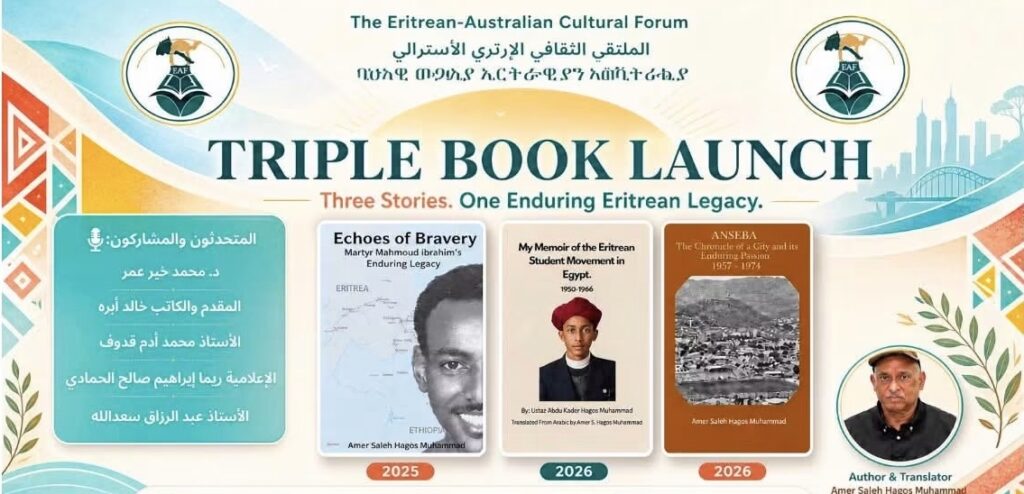
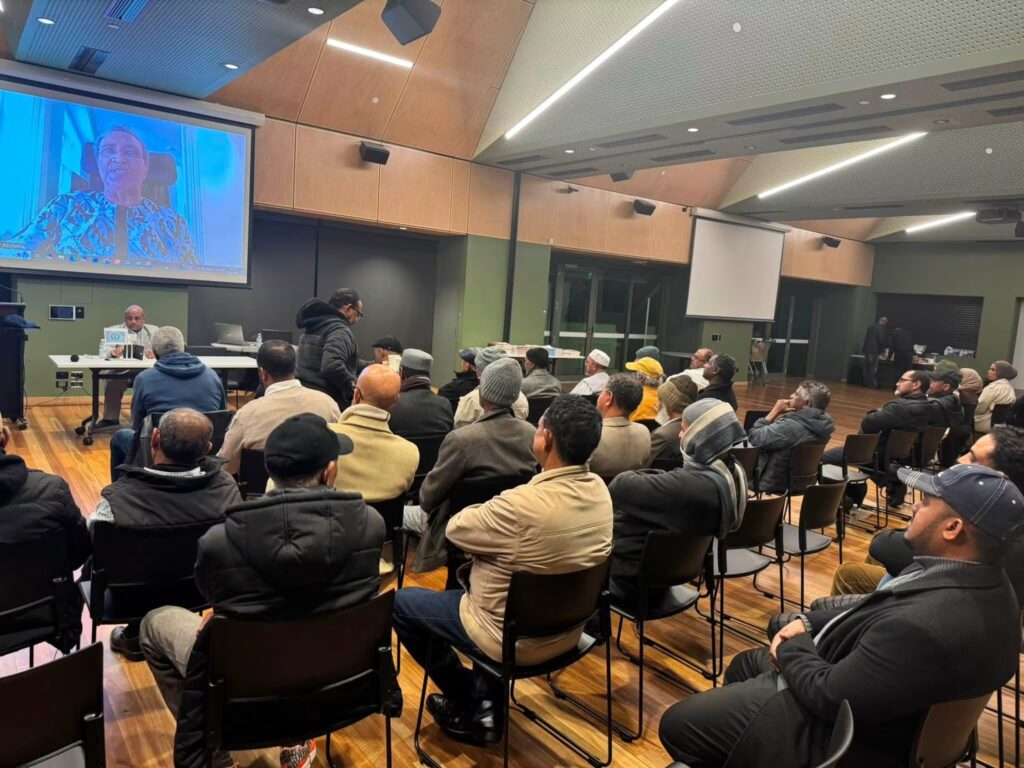
The Eritrean-Australian Cultural Forum sponsored the cultural night held this evening to launch three books by political activist and writer Amer Saleh Hagose in the Flemington suburb of Melbourne, Australia. The ceremony witnessed a large gathering of the Eritrean community in the city, and the attendees praised the level of organization and arrangement carried out by the Eritrean-Australian Cultural Forum, which is an honorable culmination of the efforts of the distinguished writer who is busy with the issues of his people and heritage.
The three books, two of which were written by him in English, include ” Echoes of Bravery: martyr Mahmoud Ibrahim’s Enduring Legacy” The book, focused on the biography of the fighter Mahmoud Shakini, also represents a documentation of the early stages of the Eritrean revolution and the pioneers of the early fighters who bore the burdens of the early stages of the Eritrean revolution. This biography of one of the Eritrean national symbols also represents a documentation of the social incubator that shaped the awareness of the martyr Shakini, which is the city of Keren, which represents a miniature image of the Eritrean people and the roles it represented and played during the stages of the Eritrean people’s struggle for freedom political and armed struggle. The book is also a testimony to the level of effort and research carried out by the writer to produce this book, making it one of the important references in the Eritrean library.
The book “The History of the Anseba Sports Team in the City of Keren, 1957-1975” The book represents an extraordinary documentation of the social, cultural and sporting life of the city of Keren, as the “Anseba” sports team represented one of the early sports teams that played a role in strengthening social ties and raising the degree of political awareness in the city, making its pioneers and fans among the first pioneers who led the underground work in the city and joined the first ranks of the revolution.
The writer Amer Saleh Hagose translated the book “My Memories of the Role of the Eritrean Student Movement in Egypt, 1950-1966” – written by the late poet and Ustaz Abdul Qadir Hagose, and translated by Ustaz Amer Hagose into English.” Ustaz and poet Abdul Qadir Hagose is considered one of the few who closely lived the experience of the Eritrean student movement in Cairo. The importance of the book comes from the fact that Cairo witnessed the start of the Eritrean revolution and was one of the tributaries of the heroes of the beginnings and leaders of the various stages of the Eritrean revolution. This is why it was necessary to translate this book into the English language due to the lack of documentation of this role in the books published in English and Tigrinya languages, which makes it an essential reference for the role played by the Eritrean student movement.
The wonderful cultural night witnessed the participation of Eritrean personalities from outside Australia, where Dr. Muhammad Khair Omar presented a review of the book Echoes of Bravery, where he explained through his reading the strengths and weaknesses of the book, but he said that the book represents an important documentation of the history of the Eritrean revolution and the struggles of the national forces in the city of Keren through the autobiographical narrative of the martyr Mahmoud Shekini.
Ustaz Abubaker Ali Osman added in his written reading, as he was unable to attend due to circumstances beyond his control that prevented his personal attendance, saying that the book was distinguished by two basic features, one of which was the sequence of the various historical stages of the struggles of our people, which exceeded the purpose of the book, but became a witness to the biography of the martyr Mahmoud Shekini.
Journalist and writer Colonel Khaled Aberra – the translator of Naguib Mahfouz’s novel Miramar into Tigrinya – also presented his review on the book Echoes of Bravery, where he stated that much of Eritrea’s history was written with non-Eritreans as outsiders, colonizers or friends, and this is why the book comes in which painstaking efforts were made by the writer, and this gives the book great credibility and has an opportunity to address others and the world because it is written in the English language.
Media personality Rima Ibrahim Saleh Ali Al-Hamdai also spoke about the book of the late poet and one of the faces of student movement in Cairo, Ustaz Abdul Qader Hagose, who documented the history of student movement in Egypt from 1950 to 1966. She focused on the role that students played in introducing the Eritrean cause to the world and gaining support and for our just cause.
Ustaz poet, and social activist, Abdul Razzaq Idris Saadallah, also presented the book of the late poet, ustaz Abdul Qadir Hagose, and his illumination about the late personality had the beauty of impact and influence, as it highlighted beautiful human images of the late poet and his tireless work in documenting and writing. This is why the book was distinguished because it was written by one of those who lived through the most prominent stages of the formation of the Eritrean student movement and its role in detonating the armed struggle.
The last word came from Ustaz Muhammad Adam Qadouf, member0f the Anseba team, the formation and activists, and the role he played in strengthening social relations between all components of the Eritrean people, and his role in supporting the national movement with many of its leaders. Although the book documents the Anseba sports team, the city of Keren, and its social work leaders, and so that it is not just a historical narrative, Ustaz Qadouf appealed to the attendees, whom consisted of big number of m Eritrean youth, to unite, reject disagreement, success through an individual or A group must be seen as a win-win for all, and the failure of an individual or group to achieve a particular task is a failure for all. In the same way, this documentation must be viewed as a success for all. However, he asked everyone to continue recording the collective memory of the cultural and social movement of the city of Keren. He called on the audience and listeners around the world to move forward and continue the work, and preserve unity and cohesion.
It is worth noting that the Eritrean Cultural Forum, since its establishment, has carried out multiple and important cultural activities and represented a great addition to a city that was characterized by activity and national participation and support in Eritrean affairs. The night was ably moderated by the great journalist, Mr. Ahmed Sharif, Chairman of the Forum, and Mr. Ari Muhammad Saleh, Secretary of the Eritrean-Australian Cultural Forum, who welcomed the attendees and appreciated their participation in the activities of the forum, and the occasion. He also praised the great role played by the writer in writing such a magnificent books. He called on the attendees not to limit their role to buying books only, but to reading them.
At the end of the ceremony, Mr. Amer Saleh Hagose signed the books.

Comments