
Italian, Ghedli, and the Languages We Inherit
Crossings II: Part One
I. Beyond the Languages We Speak
In “Multiple Languages, Many Journeys”, I reflected on the languages that accompanied me through different stages of life. Some arrived through family and community, others through classrooms, displacement, work, and encounters with people whose worlds differed from my own. Each language opened a passage into another way of living, remembering, and understanding.
But the journey left a question unanswered. Does speaking another person’s language necessarily mean we have learned to listen to that person? Language is supposed to facilitate communication. We learn words, acquire grammar, recognize expressions, and gradually become capable of understanding what another person says.
Yet comprehension and understanding are not always the same thing. Two people may speak the same language fluently and remain separated by entirely different interpretations of history. They may understand every word of an argument while failing to recognize the experiences that give those words meaning.
Conversely, two people with little linguistic fluency in common may discover, through patience and curiosity, a remarkable capacity to understand one another.
Language makes communication possible. It does not guarantee understanding. This distinction becomes especially revealing when we consider the languages Eritreans have inherited, acquired, borrowed, and occasionally left behind.
II. The Languages That Stayed, and the One That Did Not
One question raised in response to my earlier essay concerned Italian. Given Italy’s long colonial presence in Eritrea, why did Italian not become more deeply embedded in the linguistic life of Eritreans?
The question invites us to distinguish between the presence of a language and its adoption by a society. A colonial language may dominate administration, commerce, technical occupations, and certain forms of education without becoming the language through which most people conduct their intimate lives.
Italian left a visible inheritance in Eritrea’s architecture, urban life, commercial vocabulary, and everyday expressions. Certain borrowed words became so familiar that speakers might scarcely pause to consider their origins.
Yet borrowing words is not the same as adopting an entire language. Colonial education was neither universally accessible nor organized primarily to cultivate an Italian-speaking Eritrean population on equal terms with the colonizers. Access to the language was shaped by occupation, class, location, and the unequal institutions of colonial rule.
Meanwhile, Eritreans continued speaking the languages through which families, religious communities, markets, and local relationships sustained themselves.
After the end of Italian colonial rule, political and educational circumstances changed again. Italian no longer possessed the same institutional position, while other languages acquired new importance. Its partial survival, therefore, is not especially mysterious.
Languages do not spread simply because a government occupies a territory for decades. Their fortunes depend on institutions, social opportunities, intergenerational transmission, and the uses to which people put them.
There is also a temptation to interpret linguistic inheritance as a referendum on colonial history: that adopting a language implies acceptance of the colonizer, while retaining indigenous languages constitutes resistance.
History is seldom so accommodating. People borrow from those who dominate them, resist them, trade with them, and live alongside them. They may reject an authority while retaining its vocabulary, technologies, or habits. A borrowed word need not carry a declaration of allegiance.
The more interesting question is not why Eritreans failed to become Italian speakers, but how they selected, adapted, and transformed elements of the languages that entered their lives. The society was never merely a passive recipient of linguistic influence. It was also an active interpreter.
III. Ghedli: A Language Beyond Language
Another question concerns Ghedli, the Eritrean liberation struggle, and its role in shaping communication among communities.
Here we enter territory where language cannot be separated from historical experience. The liberation struggle brought together people from different linguistic, regional, religious, and social backgrounds. Its organizational demands created practical necessities for communication, translation, instruction, and cooperation.
People had to understand one another sufficiently to undertake common tasks, often under conditions where misunderstanding could have serious consequences. But Ghedli also generated a vocabulary of its own. Words such as sacrifice, commitment, liberation, unity, discipline, and national duty acquired meanings shaped by the experiences and institutions of the struggle. These words did not merely describe events. They helped organize relationships and expectations.
A person could enter the struggle speaking one language and emerge having acquired another, or at least enough of it to participate in a shared undertaking. Yet something else was taking place. People were also learning a political and moral vocabulary through which they could recognize themselves as participants in a common historical project. This achievement deserves acknowledgment.
But we should distinguish the ability to communicate across linguistic boundaries from the development of a shared framework for interpreting political life. The two may reinforce one another, but they are not identical. A common vocabulary can facilitate solidarity. It can also make disagreement difficult when particular words become inseparable from unquestioned moral expectations.
Consider unity. In one setting, unity may mean cooperation among people who retain their differences. In another, it may be understood as the suppression of differences in the name of a higher collective obligation. The word remains the same. Its political implications change.
Or consider sacrifice. For one generation, sacrifice may evoke the extraordinary demands of liberation. For another, it may raise questions about the obligations owed to those who have already sacrificed, and about the limits of what can reasonably be demanded from the living.
Neither generation necessarily misunderstands the word. They may be inhabiting different moral expectations attached to it. The language of Ghedli therefore deserves study not only as an instrument of multilingual communication, but as a historical vocabulary whose meanings have continued to evolve.
A language born of collective struggle does not cease changing when the struggle reaches its declared objective. The challenge is whether its inherited vocabulary can accommodate new experiences, new generations, and questions that its original circumstances did not anticipate.
IV. When a Common Language Conceals Different Worlds
Imagine two Eritreans conversing in impeccable Tigrinya. They share vocabulary, idioms, proverbs, perhaps even memories of the same historical events.
One invokes the liberation struggle as the foundation of national legitimacy. The other invokes the same struggle as the foundation of an obligation to build accountable civic institutions.
Both speak of loyalty. Both speak of sacrifice. Both speak of the nation. Yet the conversation becomes increasingly difficult. The difficulty is not linguistic. Neither person requires a translator. What they lack is a shared understanding of the relationship between the words they use and the historical conclusions they draw from them. Their disagreement may be substantive and legitimate. It need not arise from ignorance or bad faith.
Still, each may hear the other’s vocabulary through assumptions that make the other’s position seem almost unintelligible. Now reverse the situation. Imagine two Eritreans who speak different mother tongues, perhaps Tigrayit and Tigrinya, or Arabic and Saho. Their conversation requires patience, occasional translation, and perhaps the assistance of a third language.
Yet they approach one another with curiosity. They ask questions. They clarify meanings. They allow for the possibility that familiar concepts may carry different associations in another person’s experience. Their linguistic distance is greater, but their willingness to understand may be stronger.
The contrast suggests something important. A shared language can conceal a profound distance between people, while different languages need not prevent genuine understanding. The decisive factor is not always the vocabulary available to us, but the intellectual and moral habits with which we approach another person’s experience.
And this brings us to a paradox worth carrying beyond the present discussion. We may spend years acquiring the language of another community, only to discover that the more difficult task is learning to inhabit, however briefly, the world from which its words arise.
Likewise, we may spend a lifetime speaking the same language as our neighbors without ever seriously examining the assumptions that separate our understandings of a shared past.
This might as well be why conversations sometimes collapse precisely when everyone believes communication should be effortless. The words are familiar. The meanings are not.
One person speaks of unity and hears cooperation. Another hears conformity. One speaks of sacrifice and remembers liberation. Another hears an obligation whose boundaries have never been defined.
Neither requires a dictionary. Both may require something far more difficult: a willingness to discover that the same word has been carrying different histories. We have learned to translate languages. We have been less successful at translating the experiences that give them meaning.
The words may be shared. The worlds they inhabit are not necessarily the same. And until we recognize that distinction, we may continue speaking fluently to one another while remaining strangers to what the other is trying to say.
====================//===================
Crossings is a continuing series of reflections on language, literature, memory, and the cultural journeys through which Eritreans encounter one another and the wider world. This installment follows “Multiple Languages, Many Journeys.”
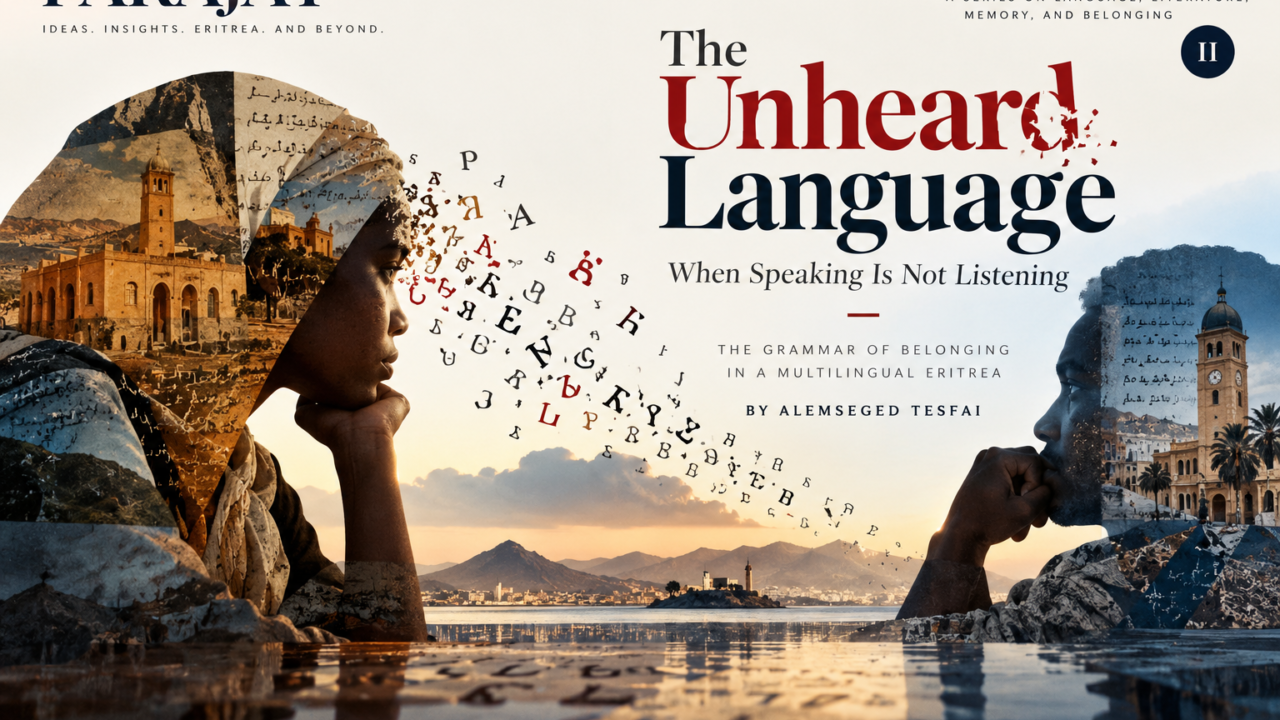
The Unheard Language: When Speaking Is Not Listening

Comments