

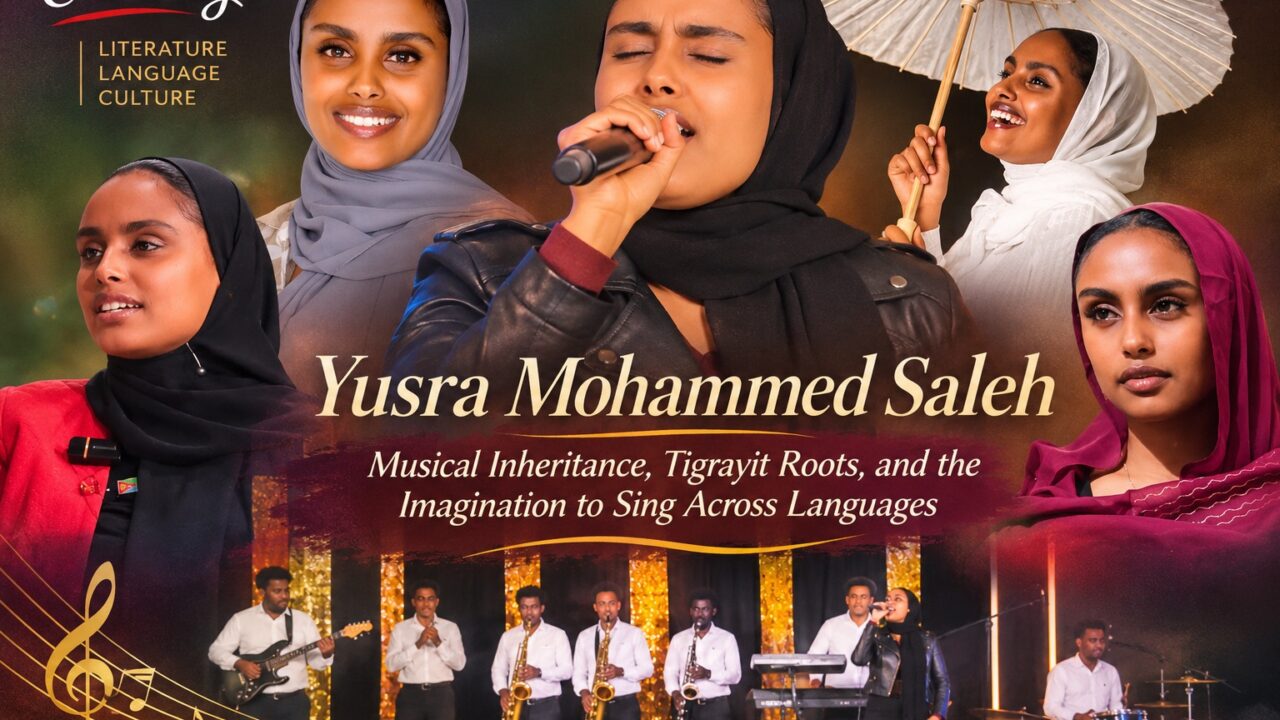
Musical Inheritance, Tigrayit Roots, and the Imagination to Sing Across Languages
There are singers whose voices announce their arrival with force, and others whose presence is felt before the first note is sung. Yusra Mohammed Saleh belongs, to my eyes and ears, to the latter tradition.
There is an understated elegance about her stage presence that reminds me of Sade, the internationally celebrated singer whose artistry demonstrates that musical authority need not announce itself through extravagance. The comparison is not one of imitation. Yusra possesses her own voice, cultural inheritance, and artistic identity. What the two seem to share is something less easily taught: the ability to command attention through composure.
There is also something about the way Yusra inhabits a performance that invites the listener to remain with her. She does not appear anxious to overwhelm the audience. Her composure allows the music to occupy the foreground. Watching her, one is reminded that performance is not always a demonstration of vocal power. Sometimes its most persuasive quality lies in the confidence to let a song unfold without unnecessary embellishment.
I have followed Yusra’s artistic development with growing admiration. I have listened to interviews, including one featuring her father, himself a musician, and watched her establish an increasingly recognizable presence within Eritrea’s musical landscape. Yet what distinguishes Yusra is not simply her voice or her graceful stage persona. It is her extraordinary linguistic reach.
She sings in Tigrayit, Tigrinya, Arabic, English, and Chinese. And, as I subsequently discovered through an interview published in December 2024, her repertoire extends further, encompassing German, Italian, and Bidawyet. Eight languages! That is an impressive accomplishment by any measure. But the more interesting question is not how many languages Yusra can sing in. It is what she does artistically by moving among them.
Artists rarely emerge from nowhere. Behind the public performance often lies a less visible history of encouragement, observation, experimentation, and sometimes resistance. In Yusra’s case, the musical inheritance is unmistakable. Her father, Mohammed Saleh, is an accomplished musician in his own right. In a published interview, Yusra recalled childhood photographs of herself sitting on his lap while he played the piano. She also remembered singing at home during his absence when he traveled to China for further studies. These are small domestic details, but they tell us something important. Music was not simply an extracurricular activity that Yusra discovered later in life. It belonged to the atmosphere of her childhood.
Her father’s influence was formative, but inheritance is not destiny. Children of musicians do not automatically become accomplished performers. Somewhere between listening, imitation, practice, and personal discovery, the child must develop an artistic identity of her own. Yusra appears to have embraced that challenge. Her early performances with musical groups and her later work as a teacher, translator, and vocal coach suggest an artist for whom music is not merely a means of public recognition. It is also a discipline to be studied, practiced, and shared.
There is something especially appealing about that combination: the daughter who inherited a musical environment becoming an educator who introduces others to music. The inheritance continues, but its expression changes. Eritrea’s linguistic diversity is frequently described through the familiar enumeration of its nine recognized ethnolinguistic communities. We name the languages, acknowledge their existence, and invoke cultural diversity as a national characteristic. But what does that diversity sound like when it is brought to life by a single performer? Yusra offers one answer
Her Tigrayit background provides a point of departure, but it does not confine her artistic imagination. She moves into Tigrinya, Arabic, English, Chinese, and other languages without treating linguistic difference as an insurmountable barrier. This is worth considering carefully. To sing in another language requires more than memorizing unfamiliar words. Pronunciation matters, certainly, but so do phrasing, musical expression, and the relationship between language and melody. Each language offers different possibilities for rhythm, emphasis, and emotional interpretation. A technically accurate pronunciation does not necessarily produce a convincing musical performance. The artist must also find a way to inhabit the song.
I would hesitate to claim that Yusra has mastered every expressive tradition represented in her repertoire. That would require closer examination of individual performances. But her willingness to enter these different musical worlds already tells us something about her artistic curiosity. It also challenges an assumption that sometimes enters our cultural conversations: that fidelity to one’s linguistic heritage requires remaining within its boundaries. Yusra suggests another possibility.
One can be deeply rooted in Tigrayit while finding artistic expression in Chinese. One can sing in Arabic without abandoning Tigrinya. One can approach English-language music without surrendering the distinctive musical inheritance of Eritrea. The languages need not compete for ownership of the artist. Indeed, their coexistence may become part of what makes the artist distinctive.
A Journey That Has Already Crossed Borders: Yusra’s international experience is not merely aspirational. In her December 2024 interview, she described traveling to China and participating in a Chinese-language proficiency competition. She and a fellow Eritrean participant had earned the opportunity to represent their country after succeeding in a local competition. She also described presenting Eritrean cultural clothing and symbols during the international event.
This is an important detail because it reveals that Yusra’s interest in other languages does not necessarily lead her away from Eritrean culture. It can provide another means of introducing that culture to unfamiliar audiences. Her work teaching Chinese-language songs at the Confucius Institute in Asmara adds another dimension. Here, the performer becomes a mediator between musical traditions, helping students approach a language through singing.
We should not underestimate the significance of such work. Language learning is often imagined as a formal process of grammar, vocabulary, and examination. Music offers another entry point. A melody can make unfamiliar sounds memorable. A song can introduce emotional associations that a textbook may struggle to convey. Yusra’s career brings these activities together: singing, language learning, teaching, and cultural presentation. The relationship is not accidental. It appears central to her artistic development.
When the Machine Could Not Hear Tigrayit: My interest in Yusra recently led me to a new Tigrayit song shared on social media. The performance was captivating, but an unexpected discovery emerged when I examined the automatic transcription associated with the video. Although the song was performed in Tigrayit, the transcription appeared largely in Arabic script, producing a sequence of words that made little sense as written. The problem was not the singer’s language. It was the technology’s apparent inability to represent that language accurately.
I encountered a similar difficulty with an EriTV dramatic production in Tigrayit. Its automatic transcription contained recognizable Arabic expressions alongside numerous unintelligible passages, with occasional fragments of English and even characters from another writing system. The contrast was striking. Here were Eritrean artists producing music and dramatic dialogue in a living language, while the digital system responsible for representing their words struggled to recognize what it was hearing.
We should be precise about the technical problem. Automatic speech recognition and machine translation are different technologies, and a transcription failure does not establish that a language cannot be translated digitally. Nevertheless, the episode raises a larger question about linguistic visibility. Languages with extensive digital resources enjoy advantages that speakers of less technologically represented languages cannot always take for granted. When a language is poorly supported by speech-recognition systems, its speakers may find their songs, interviews, and conversations difficult to search, subtitle, archive, or make accessible to wider audiences.
A language does not become less alive because a machine cannot recognize it. Yet in an increasingly digitized world, what machines cannot recognize may also become what archives fail to preserve and future generations struggle to retrieve. I know individuals who are working to expand Tigrayit’s presence in digital translation technologies. Their efforts deserve encouragement, particularly if they contribute to the linguistic resources needed for future applications. The irony remains compelling. Yusra can carry her voice across multiple languages. The technology has difficulty following her when she returns to Tigrayit. That is not a limitation of the language. It is unfinished work for the technological world.
Beyond Eritrea’s Borders: Within Eritrea, Yusra has attracted attention through her performances and public appearances. Yet her international visibility remains modest relative to the range of her artistic activities. This is not an unusual situation for artists working in countries whose cultural industries have limited access to international promotion, distribution, and touring networks. Talent alone does not guarantee recognition. An artist may possess considerable ability and still require producers, promoters, festival organizers, professional networks, and institutional support to reach new audiences.
For Yusra, the possibilities are particularly interesting because her repertoire already reaches beyond one linguistic community. An Eritrean cultural festival in Europe might introduce her to diaspora audiences familiar with Tigrayit and Tigrinya. An international music event could present her multilingual performances to listeners encountering Eritrean musical traditions for the first time. Educational and cultural exchange programs could draw upon her experience as both performer and teacher. These are possibilities, not predictions. International success depends upon artistic development, opportunity, professional preparation, and the choices of the artist herself.
But the larger point remains: Eritrean cultural institutions, diaspora organizations, and independent promoters could do more to create pathways through which emerging artists reach audiences beyond the country’s borders. Such opportunities should not require artists to abandon the languages that distinguish them. Quite the opposite. The international appeal of an artist like Yusra may reside partly in her ability to bring those languages into conversation.
The more one encounters Yusra Mohammed Saleh’s performances, the more apparent it becomes that her artistry cannot be measured simply by the number of languages in which she sings. Her multilingual repertoire is impressive, certainly. But beyond that accomplishment stands an artist whose musical inheritance, curiosity, and willingness to explore different traditions have shaped a distinctive artistic journey.She belongs to a generation of Eritrean performers drawing upon inherited cultural traditions while engaging musical and linguistic worlds far beyond them.
Her father’s musical influence remains part of that story. So does her Tigrayit background. So do the classrooms, competitions, performances, and cultural encounters through which she has developed her abilities. What makes her journey especially compelling is the way these experiences complement one another. Her engagement with other languages does not diminish her Eritrean musical inheritance. It offers additional possibilities for sharing that inheritance with audiences who might otherwise never encounter it.
There is much to appreciate in what Yusra has already accomplished, and much to anticipate as her artistic journey continues. Her voice begins somewhere. It does not have to end there. The question is not whether she can cross linguistic boundaries. She has already demonstrated that willingness. The question is whether those who possess the means to open cultural doors are prepared to list
Comments