
Fathi Othman
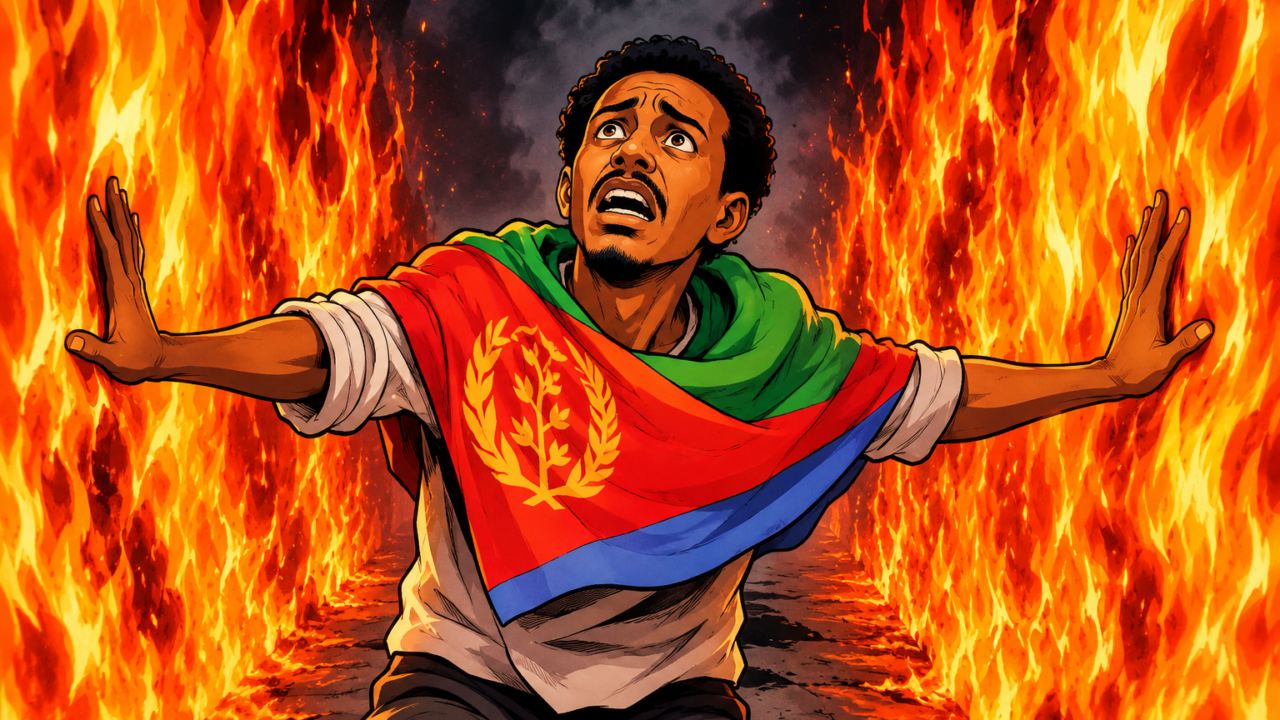
For three decades, the Eritrean people have been forced to endure a “slow-burning fire”—one that has scorched both their skin and their hearts. Now, they look on with trepidation toward another fire, one that may sweep in from beyond their borders—a conflagration whose true scale will only be revealed by the destruction it leaves in its wake. It is, in every sense, an unenviable position—a plight that, remarkably, many fail to even perceive.
Eritreans in the diaspora seem capable only of spawning further divisions, as if they were operating within a biological laboratory; thus, the blame directed at them by those inside the country is well-founded with every new instance of regression or fragmentation.
Amidst these raging, unceasing flames—and the fearful anticipation of a catastrophic inferno—the hearts and minds of the people have become unmoored. Such a reaction is natural in times of crisis; yet, when the hearts of those who lead public opinion and political action also lose their bearings, the situation becomes truly calamitous. One continues to hope that those with wisdom and discernment will remain steadfast and provide sound guidance—a hope that never fades.
The reality in Eritrea today is that the “slow fire” of tyranny has consumed the flesh and reached the bone. Under the rule of Afwerki—a regime built on fear and intimidation—Eritrea has been transformed into a crippled, grotesque shadow of itself. Yet, despite this, Eritrea is not Afwerki, and Afwerki is certainly not Eritrea. The nation has simply taken on the features of oppression and corruption, lying bedridden for a long, long time.
Can its salvation and recovery from the scourge of tyranny truly be achieved by inviting an external force—one whose agenda may well extend far beyond merely removing Afwerki from the political landscape?
To advocate for such an option is akin to fleeing the scorching heat of the desert only to fall into a fire—or, as the saying goes, jumping from the frying pan into the raging flames. We reiterate our previous position: any change imposed from the outside—arriving on the back of an Ethiopian tank or any other foreign vehicle—holds no promise of betterment for the country or its people.
Recent history teaches us that Afwerki—who is currently inviting all manner of dangers—was the very person who first brought in Ethiopian forces and thrust them into purely Eritrean affairs. He enlisted the Tigrayan front during the civil war against the Eritrean Liberation Front in the early 1980s; and what was the outcome of that foreign intervention?
As for the current Ethiopian government, it is neither the most suitable nor the most qualified partner to reshape the political reality in Eritrea. Why?
Because any partner in such a desired change will inevitably demand their “share”—in full—of the gains from the transformation they helped bring about (especially through bloodshed). At the very least, this would mean installing a puppet government in Asmara that takes its orders from Addis Ababa, securing for Ethiopia things it could not have even dreamed of prior to this so-called change.
Furthermore, should war break out, it is an unbridled steed that cannot be reined in by mere desires or wishful thinking—such as the notion of “wanting Eritrea, but not its people,” or lamenting the national sovereignty threatened by the looming danger of Ethiopian aggression. War, like any other, demands specific prerequisites: a resolute political will, supportive political alliances, inexhaustible financial resources, infallible strategies, and formidable, lethal weaponry. Does Eritrea—scorched as it is by Afwerki—possess these requirements to survive the ravages of war, let alone emerge victorious? I do not subscribe to the view that issues must be reduced to a binary choice—either submissive acquiescence to Isaias Afwerki, or the enthusiastic endorsement of Abiy Ahmed’s intentions. Those who defend Afwerki—framing his rule as a “nationalist” necessity in the face of an imminent threat—are, in effect, driving others to welcome his removal, whether by Ethiopian hands or any other means; the primary objective becomes simply his disappearance from the scene. Such is the inevitable consequence of this dogmatic, exclusionary stance.
Given that the Eritrean question—especially at this juncture—is a matter of broad national concern, no single group has the right to monopolize it or issue “certificates of patriotism.” This is particularly true for those who, from the comfort of snow-covered cities abroad, shout incessantly about the dangers facing the homeland—acting as if they alone possess the legendary, far-seeing vision of Zarqa al-Yamama. Consequently, the framing of the situation as a choice between Abiy Ahmed and Isaias Afwerki leads only to a dead end. Others propose a different “solution”: leaving the country under the rule of a military clique—a so-called “internal national” change—that would supposedly eliminate the tyrant and the looming threat through some “magical” coup, with little regard for what might follow. This is a pit whose true depth will only be revealed once we find ourselves at the very bottom, trapped alongside yet another predator.
Two types of “human devils” are at work, shaping this false dichotomy between Isaias and Abiy: one is a “mute devil” who remains silent when the truth should be spoken; the other is a “horned, articulate devil” who embellishes falsehoods and presents them to the public as if they were the truth. Caught between the two, we find ourselves crushed like grain between the heavy stones of a mill—a process that grinds down our resolve long before it crushes our very bones. It is indisputably clear that Afwerki has been a suffocating, dark cloud, obscuring the sun from the nation and stripping it of its freedom and dignity. As for the “beacons of light” promised by Abiy Ahmed, they are fueled by hatred, shortsightedness, and ill intent.
The solution to this predicament does not lie in supporting one side against the other. Rather—however arduous it may be—the path forward requires rejecting and resisting tyranny, while simultaneously opposing any attempt to dismantle it through external aggression or invasion. This approach demands a balance of wisdom and courage—one that does not tip the scales in favor of tomorrow’s oppressor at the expense of today’s.
The Eritrean people have previously ventured into revolutionary struggle without a long-term vision; the inevitable result was stumbling, disarray, and the nominal independence we experience today.
The author of this piece makes no claim to any extraordinary, superhuman foresight. Yet, in times of stifling national crisis, suppressing inquiry, burying the truth, and denying rights are the first steps toward ruin. This is precisely what manifests in the current framing of the crisis—presenting only two, mutually exclusive options, while brandishing the cudgel of “treason” against dissenters. It is as if the country were the private property of a select few, rather than belonging to all—when, in reality, the stakes are far greater and more profound.
For what purpose, then, is this narrowing of a broad, complex reality being pursued?
Eritrea between two fiers



Comments