


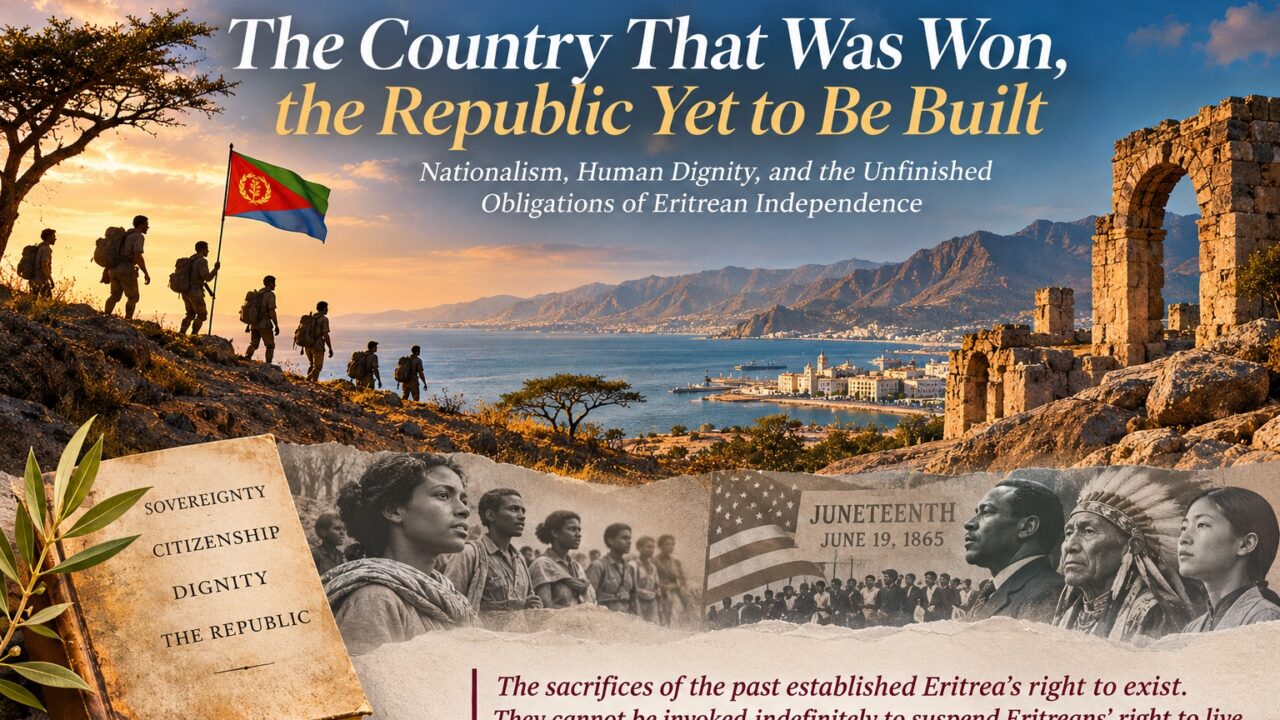
Recent discussions about Eritrean nationalism have revived an unfinished question: What was Eritrea liberated for? Some defend nationalism’s historical legitimacy as an instrument of self-determination. Others question its moral claims upon individuals, particularly when governments invoke national survival to restrict freedom, family life, and personal conscience.
Both concerns deserve consideration. Nationalism has inspired emancipation and justified exclusion. It has united communities against domination and enabled governments to confuse loyalty to the country with obedience to those who govern it. The more consequential question concerns the relationship between the country won through extraordinary sacrifice and the republic independence was supposed to make possible.
Eritrea’s struggle for independence was not simply a military campaign to redraw a political map. It displaced families, interrupted education, consumed decades of productive life, and left bereavement extending far beyond the battlefield. Its achievement of sovereignty was real. So was its human cost. Independence created two obligations: defending territorial integrity and establishing a political order worthy of the sacrifices made for it. The first cannot permanently displace the second.
The territory is not merely a landscape, and the people are not merely instruments of its defense. Territory matters because communities build their lives, preserve memories, and exercise political belonging within it. Human dignity matters because a country without the freedom and welfare of its inhabitants risks becoming a sovereign abstraction.
To place land and people in opposition misunderstands their relationship. But subordinating people indefinitely to the land betrays sovereignty’s purpose. The liberation struggle was not fought for an empty geographical space. Eritreans imagined a homeland where their children might escape the subordination and insecurity that had defined their own lives.
The promise of independence was therefore larger than its achievement. A liberation movement may demand extraordinary sacrifices during war. But a government ought not indefinitely govern civilians as though the war never ended. Wartime discipline is not a sufficient philosophy of constitutional government. Nor can one generation’s sacrifices become an inexhaustible political debt imposed upon those who follow.
Eritrean nationalism united diverse religious, linguistic, ethnic, and regional communities around self-determination. Its legitimacy rested not upon Eritrean superiority but upon the right to determine a collective political future. Yet nationalism may be inclusive in its understanding of the nation while remaining authoritarian in its exercise of power. A government may recognize religious and ethnic diversity while denying everyone meaningful political freedom. The absence of sectarian exclusion does not establish constitutional citizenship.
There is a distinction between horizontal exclusion, where one community claims superior ownership of the nation, and vertical domination, where the state claims authority over all communities. A political order may reject the former while practicing the latter. The citizen is both a member of a political community and a human being whose relationships, aspirations, and rights cannot be reduced to state security.
For Eritreans, self-determination was itself a means of recovering dignity. The problem begins when political authority transforms a community of citizens into an institution claiming ownership over them. The nation belongs to its people. Its people do not belong to the state.
American constitutional history offers an illuminating comparison, not because it mirrors Eritrea’s experience, but because it exposes the distance between founding promises and lived freedom. Consider Juneteenth. On June 19, 1865, Union General Gordon Granger announced emancipation in Galveston, Texas, more than two years after Lincoln’s Emancipation Proclamation. A right proclaimed is not necessarily a right enjoyed.
Emancipation did not immediately establish equality. African Americans confronted segregation, disenfranchisement, and racial violence. Through Reconstruction, the civil rights movement, and continuing struggles, they compelled the republic to confront its contradictions.
Other communities similarly challenged constitutional exclusion. Native Americans endured dispossession, forced removal, and broken treaties. Chinese immigrants confronted the Chinese Exclusion Act of 1882. Japanese Americans, including citizens, were forcibly incarcerated during World War II. Hispanic and Latino Americans struggled over land, labor, education, and political representation. These experiences are not footnotes to American democracy. They are central to understanding its development.
Were these communities merely beneficiaries of enlightened institutions? Or were they historical agents who compelled those institutions to honor their professed principles? One is entitled to admire the American Constitution. But admiration must not confuse the America that was constitutionally promised with the America that generations of excluded people struggled to bring into existence.
American democracy became more inclusive through civic mobilization, constitutional amendments, legislation, and sustained resistance. Its unfinished history demonstrates that citizenship must remain open to criticism and transformation. Those who demanded equality were not necessarily abandoning the republic. They were demanding that it answer to its promises.
The American and Eritrean experiences differ profoundly, but one distinction remains instructive: The achievement of nationhood and the realization of citizenship are not the same historical event. Eritrea achieved independence in 1991. Yet independence did not settle how sovereignty would be exercised, political authority constrained, or citizens empowered to determine their future.
These were obligations independence created, not questions it automatically answered. The history of liberation belongs to more than the establishment that inherited political authority. It belongs to fighters across different organizations, civilians, families, workers, students, caregivers, and diaspora communities whose sacrifices sustained the struggle. No organization possesses exclusive ownership of that collective history.
Criticizing a government does not mean rejecting the nation. Demanding accountability does not diminish liberation’s sacrifices. Defending territorial integrity does not require suspending citizenship. The unfinished work of independence is not a repudiation of the liberation struggle. It is the obligation that struggle bequeathed to the republic.
Renewed confrontation between Eritrea and Ethiopia gives these questions urgency. Eritrea’s sovereignty is not conditional upon approval of its government. National independence and the legitimacy of a ruling establishment are separate questions. Yet genuine external threats do not extinguish domestic accountability. A state may confront real dangers while invoking them to justify restrictions on its citizens. Conversely, criticizing authoritarianism does not make external threats imaginary. Both realities can coexist.
Eritreans have endured liberation war, the devastating 1998–2000 border conflict, prolonged national service, displacement, and recurring regional crises. Such accumulated sacrifice should deepen our reluctance to treat further sacrifice as the ordinary condition of national existence. Political leadership must do more than prepare citizens for another catastrophe. It must exhaust the possibilities of preventing one.
Diplomacy is not an abandonment of national defense. It is an instrument for preserving both the country and its people. A country’s security cannot be measured solely by the territory it retains. It must also be measured by the lives its people are able to lead.
The question is not whether Eritreans should love their country, but what political relationship that love should establish. Love of country need not demand silence before injustice. Criticism of injustice need not imply indifference to national survival.
A mature national consciousness must distinguish the country’s enduring interests from those temporarily exercising political authority. Its worth must be measured not merely by the loyalty it inspires, but by the freedoms it protects and the questions it permits citizens to ask.
The republic yet to be built requires institutions beyond permanent liberation credentials, citizenship independent of political loyalty, and security that protects human dignity rather than indefinitely suspending it. The country that was won deserves defense. The republic that remains to be built deserves no less commitment. The sacrifices of the past established Eritrea’s right to exist. They cannot be invoked indefinitely to suspend Eritreans’ right to live.
The generation that won independence did not exhaust freedom’s meaning. It created the responsibility to make freedom a lived reality for those who followed. The most fitting tribute to those who sacrificed so much is not to ask how much more their descendants must surrender, but what kind of country their sacrifices were meant to make possible.
Reference
Asmerom, T. (2026). 1ይ መዓልቲ ሰሚናር — ሳዕቤን ሃገራውነትን ክእለት ዘየሰነዮ ሓላፍነትን! [Video]. YouTube. https://www.youtube.com/watch?v=GHH2rd8sJyA

Comments