


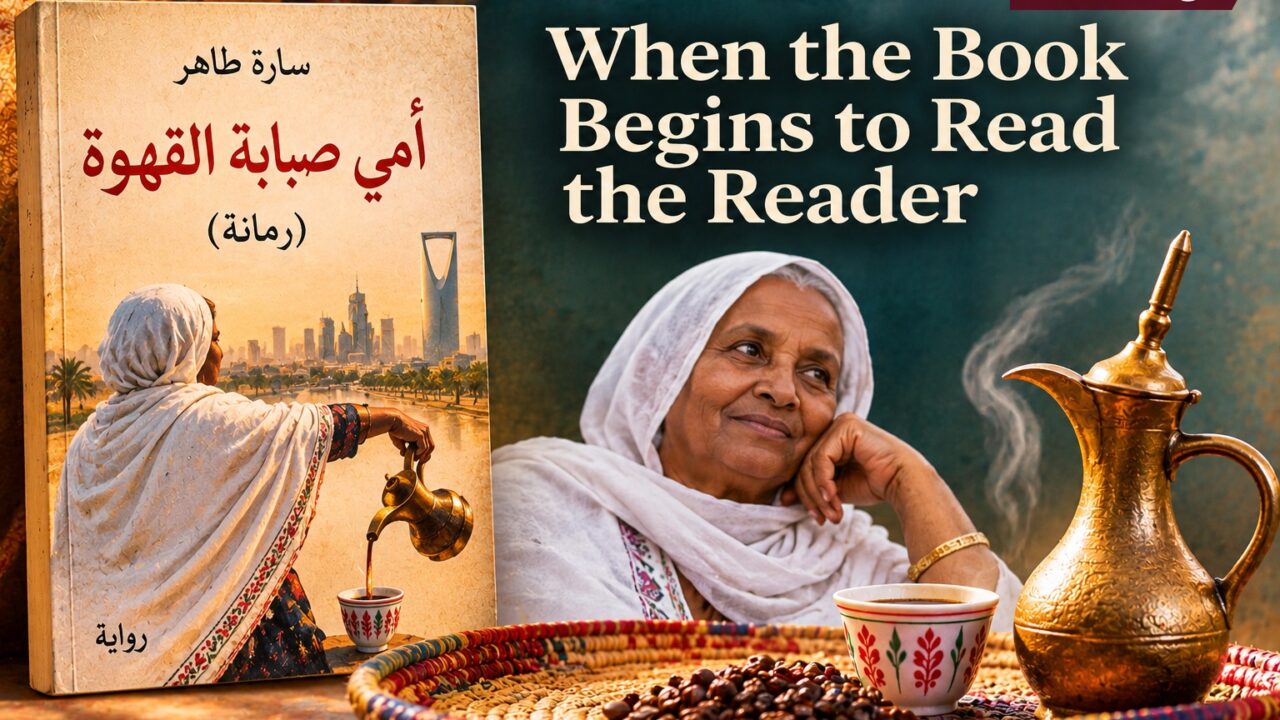
Amer Hagos, Rummana, and the Memory We Bring to Literature
There is a moment in reading when the book ceases to be something before us and begins to resemble something within us. A character’s journey awakens a memory. A place recalls another place. A stranger’s suffering becomes strangely familiar. We continue turning the pages, but the distance between the story and our own lives has begun to disappear.
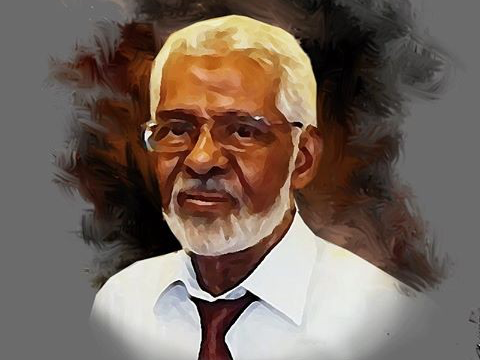
This is one of literature’s remarkable powers. It is also one of reading’s most interesting complications. Amer S. Hagos’s recent Farajat review of Sarah Taher’s My Mother, the Coffee Pourer (Rummana) offers an unusually revealing example of this encounter. His essay begins as a literary appreciation, develops into a personal recollection of exile, and eventually becomes a meditation on motherhood, displacement, political failure, and the unfinished relationship between Eritreans and their homeland.
What interests me here is not whether Amer has interpreted the novel correctly. Rather, it is what happens to interpretation when the reader discovers that the story under examination has already entered his own life. At what point does reading become remembering? And when memory enters the room, who is interpreting whom?
Amer does not approach Rummana’s story as a detached observer. He brings to it his departure from Eritrea in 1975, his experience of refuge in Sudan, and his subsequent familiarity with life in Saudi Arabia. The novel’s account of displacement, the sponsorship system, family vulnerability, and the uncertainty of belonging therefore reaches him through experiences he already knows. He describes how the narrative awakened memories he had not consciously revisited. Sometimes he recognized himself; at other moments, people and families he had encountered. This is where the review becomes especially interesting.
The conventional understanding of reading imagines a movement from the text toward the reader: the writer presents a world, and the reader enters it. But Amer’s experience suggests another movement operating simultaneously. The reader’s accumulated history enters the text, selecting, amplifying and sometimes rearranging what matters most.
Two people may read the same account of Rummana’s journey and encounter different stories. One may recognize the legal precariousness of migrant life. Another may be drawn to the mother’s economic struggle. A third may see the painful consequences of family abandonment. Someone unfamiliar with these circumstances may encounter an entirely new social world. None necessarily reads dishonestly. Each arrives with a different history of attention. The question, then, is not simply what the book contains. It is also what the reader is prepared, or compelled, to recognize.
Amer takes his interpretation further by bringing Rummana into conversation with two celebrated maternal figures: Nilovna in Maxim Gorky’s Mother and Radha in Mehboob Khan’s Mother India. The comparison is imaginative and revealing. Nilovna moves from fear and domestic submission toward political participation. Radha confronts poverty, exploitation, and a devastating conflict between maternal love and communal obligation. Rummana struggles through war, widowhood, economic insecurity, and decades of displacement. Amer identifies sacrifice as the thread connecting them. Yet their differences deserve equal attention.
Nilovna’s transformation belongs to a narrative of political awakening. Radha’s story is deeply entangled with the moral imagination of a newly independent nation. Rummana’s experience unfolds largely outside the protective embrace of national belonging. Her struggle is not primarily to represent a nation or join a revolutionary movement. It is to sustain a family across places that never entirely become home.
These distinctions complicate the apparent universality of motherhood. When we call all three women embodiment of sacrifice, we recognize something profoundly human. But we also risk reducing different histories to a single moral category. A mother is not merely an illustration of endurance. She has preferences, disappointments, contradictions, and desires that may extend beyond the lives of her children.
What happens to those dimensions when literature, or its readers, elevates her into a symbol? Perhaps the most responsible comparison does not end by declaring that the three mothers are one. It begins by asking what each mother’s particular circumstances reveal that the others cannot. Similarity opens the conversation. Difference gives it depth.
There is another movement in Ameri’s review worth examining. Rummana begins as Sarah Taher’s mother, a woman with a particular family, history, and journey. Gradually, she becomes representative of Eritrean mothers more broadly. The transformation is understandable. Communities displaced by war often preserve their histories through figures who appear to embody collective endurance. Mothers become custodians of memory, language, hospitality, and continuity. Yet symbolism carries a peculiar burden.
The more completely a person comes to represent a community, the easier it becomes to overlook the individuality that made her story worth telling. Rummana’s experience is not simply that of an Eritrean mother. It is also the experience of a particular woman negotiating relationships, obligations, economic constraints, and successive displacements. Her movement from Eritrea through Sudan and Saudi Arabia, and eventually to Canada, raises questions that cannot be resolved through admiration alone.
What does belonging mean after forty years in a country that never grants full membership? What becomes of home when the place one has learned to inhabit is itself another station of departure? And what happens when old age demands yet another beginning? These questions move us beyond the language of sacrifice toward the arrangements that make sacrifice necessary. Admiration for endurance should never prevent us from asking why so much endurance was required.
Amer’s review also raises a question about the authority of lived experience. His personal history gives him access to dimensions of the novel that another reader might miss. He recognizes the social consequences of sponsorship arrangements, the vulnerability of widowed families, and the sometimes painful distance between communal ideals and actual conduct. That knowledge monumentally enriches his interpretation.
But lived experience, however valuable, does not eliminate the need for interpretive caution. Recognition can illuminate a story. It can also tempt us to complete another person’s experience with details borrowed from our own. This is not a criticism peculiar to Amer. It is a condition of reading itself.
We seldom encounter literature without bringing expectations, memories, and emotional investments. The task is not to eliminate these influences, which would be impossible, but to become more conscious of their presence. Here, the question of listening returns.
Can we recognize ourselves in another person’s account without assuming that we have exhausted its meaning? Can we allow the unfamiliar portions of a familiar story to remain unfamiliar long enough to teach us something? The distinction matters.
To say, “I recognize this experience,” is to establish a connection. To say, “I therefore know this experience completely,” is to close the conversation. Responsible reading requires the first without surrendering to the second.
One of the most affecting passages in Amer’s review concerns Rummana’s departure from Saudi Arabia after approximately forty years. The reader might expect that such a long residence would eventually produce stability. Instead, another migration begins, this time toward Canada. Amer wonders what awaits her there: a different climate, unfamiliar customs, another language, and the possible disappearance of the social rituals through which belonging had been sustained.
The coffee gathering becomes especially significant. Coffee is not merely a beverage in this narrative. It organizes hospitality, conversation, memory, and the small assurances of recognition that make daily life bearable. To leave such a world is not simply to change addresses. It is to risk losing the social language through which one has learned to inhabit a place.
Yet Canada need not be understood only as another loss. It may also offer possibilities of security, belonging, and renewed relationships that the earlier chapters could not provide. We do not know how Rummana will experience this next stage. And perhaps that uncertainty is precisely what the reader must respect. A story can remain unfinished without becoming incomplete. Sometimes its most important invitation is to resist supplying an ending that satisfies our own expectations.
Amer concludes by urging Eritreans to record the stories of their mothers and fathers before those memories disappear. It is an appeal worth taking seriously. But the preservation of memory involves more than collecting accounts. It also requires examining how we receive, interpret, and transmit them.
Every generation inherits stories already shaped by earlier readers. Some become exemplary. Others disappear because they do not fit the prevailing image of courage, sacrifice, patriotism, or belonging. The reader therefore participates in the making of collective memory, whether consciously or not. This brings us back to the central question.
When Amer reads Rummana, he encounters Sarah Taher’s account of her mother. He also encounters his own past, the experiences of other displaced Eritreans, and literary figures whose stories have traveled across languages and generations. The novel becomes a meeting place for several histories. What makes his review valuable is not simply the admiration he expresses for Rummana. It is the visible movement of his own memory through the act of reading.
He allows us to witness the reader becoming part of the interpretation.And that, perhaps, is where Reading the Reader acquires another meaning. We read a book to encounter a world beyond ourselves. But sometimes the book turns toward us, exposing the memories, assumptions, and emotional loyalties through which we encounter that world.
The challenge is to recognize this encounter without allowing our own reflection to obscure the person whose story brought us there. For literature does not merely ask whether we can see ourselves in another’s experience. It asks whether, having recognized ourselves, we can still make room for the other. And perhaps that is when the most difficult reading begins.
Comments