

By Fesseha Nair Zemicael
- Introduction
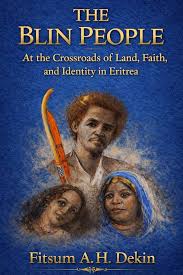
Writing a book review is one of the fundamental skills that every person must learn. It is my first time to review a very important book written by Fitsum Asfaha Deakins under the title, “The Blin People at the Crossroad of Land, Faith and Identity in Eritrea.” Published via Amazon year 2026. The cover of the book reflects the Blin identity with 543 pages.
I was motivated to write this review because after reading the book I have collected great knowledge about the Blin people’s livelihood in the past, present and future expectations.
The Authors prior work, his academic discipline is natural science and he is prolific writer. He has written other books and articles related to this historical book. Having had this information, I have been convinced to review what I have read and understood on the historical narratives and contents based on evidence. The book focuses on how the Blin people faced both internal and external threats to preserve their land, faith and identity. The book is organized into three parts, each part holding chapters organized chronologically and thematically by historical analysis.
Part one
History of the people and the region
This part deals with the origin of the Blin people inhabiting today’s land called by different names, the land of Bogos, Senhit and today, Region Anseba. The four chapters in this part trace the Blin people who they are and the land they lived on how important it was for the European colonialists. The chapters are well organized chronologically and thematically by historical facts from general to specific. The arguments are based on data, narrative, with anecdotes supported by evidence. What most attracted my attention was the growing interest of foreign explorers and scholars in this region inhabited by the Blin people. The author of this book has written in detail how the Bogos land an African Eden became the Apostolic Prefecture of Abyssinia until the early twentieth century. It is this historical document that makes the social media elites denounce the true story of the land, faith and identity of the Blin people based on historical evidence.
Part Two
The Contemporary Blin People
This part of the book is organized in chapters from chapter five to chapter twelve. Issues analyzed in the part are,
- Region
- People
- Social organization
- Livelihood system
- Religion
- Education
- Political and governance system
- Crimes and repression in the region
- Region: The Blin land
The author explored the geographical position of the Blin people with its natural resources, topography and climate, fauna and flora, districts and surrounding villages. The author criticized the changing of Blin names by the dominant languages of Tigrinya and Tigrait. For example, the name Keren is translated as a mountain but by the Blin historians it comes from “ Kirgna”ክርኝ ( see late Memhir Afa Gebres book ) because the place was full of stones.
- The book about people
The author has introduced the Blin people’s groups associated with their ancestry rather than descentry. In his investigation he has referred to many books written about the Blin and in contrast he has divided the modern Blin people into two parts, northern and southern Blin. He preferred this division instead of the old names, like that of Bogos ( Senhit or Terqe ) and Halhal ( Taqur ) I think why he has chosen this is to include all the people of Blin living in these areas regardless of the time they came to live in this area, all are Blin. The author has deeply analyzed the structure of the Blin people divided in clans and subclans. What most important in this section was that whatever nicknames they have, whatever culture they adopt, whatever identity they aspire to all the people in Eritrea are Cushitic except few. (See Abba Yishaq Ghebreyesus book) The Blin ethnicity are settled around Keren city and in Keren itself. All the Blin people regardless of their patrilineal lineages live together under the principle of Bliness, this is the main point to be held this time in order to preserve your identity. About population size of the Blin people it is only estimation, there has never been census before and after the Eritrean independence but some writers like Mr. Woldeyesus Ammar and later Memhir Micael Gaber said that the population of the Blin people increases every 25 years by 50000. Today, I think the population of the Blin in Eritrea and diaspora exceeds 500000.
- Social organization
This chapter examines the social institutions under pre-colonial and colonial ages. In pre-colonial times the social organization was based on kinship. The author writes critically the dynamics of social organizations by the European explorers, missionaries, and self -taught researchers not based on realities. The Blin traditional legal systems were broadly discussed under the Italian rule and British divide and rule system. The recent social situation after Eritrean independence, the three groups of Blin adopted a legal system by the support of Blin officials serving in the Eritrean government. This legal system was not taken as reconciliation by the head leader of the Eritrean government and is not functioning at this time. The books’ critique on social interaction pre-colonial period were well formulated.
- Livelihood system
The livelihood of the Blin people is diverse. The production forces are land and labour. The book has surveyed deeply the different product activities, crop farming the main activity and livestock herding but later on or at this time non-farming activities like business, now at this time remittances from the diaspora has been crucial to the Blin livelihood at home Eritrea. There are also community activities that promote cooperation among the Blin communities at home and diaspora. The author has brilliantly analyzed the livelihood of the Blin people.
- Religion
The author had explored deeply the historical and changes and acceptance of Christianity. Blin were first followers of Orthodox Tewahdo Christians. The book traces some historical monasteries that the Blin people were orthodox Christians but were cut of from the Abyssinina plateau due to power struggle among various warlords. When the Blin lost contact with Abyssinian plateau because of various raids from the rulers of the south and north by the mahdists they embraced islam and Catholicism. The author surveyed the coming of Catholicism from the second crusade time in Abyssinia and how it spread. The first missionaries were the Vincentian order. During this time Keren became the center of the catholic church. When the Italians occupied Eritrea the Vincentian missionaries were replaced by the Capuchin congregation. The book has also taken how islam and other Christians spread in the Blin land.
- Education
The development of education in the Blin people from informal to formal, the author has described well the time period, major events under pre-colonial and colonial times. It is true that informal education not literary begins at home by oral training. The book has laid down the process of education development with historical argument in the land of the Blin people.
- Political and Governance System
The book on the political and governance systems affected the life of the Blin people from the late nineteenth century to this time are well discussed both chronologically and thematically. The author has supported his argument with historical evidence, how it was during the Italian colonialism, British administration, Ethiopian occupation and now after the independence of Eritrea.
- Crimes and Repressions in the Region
In this chapter, the author highlighted briefly the most prominent crimes experienced by the Blin people both by the Ethiopian occupation and liberation fronts, he included also the repressions and dictatorship of the ruling party of the current regime in Eritrea.
Part 3
The Blin Language
The author traced the origin of Blin language in relation with the Agew and the Ethiopian- Eritrean Semitic languages chronologically and thematically. He presented the relationship of the Agew language parts diagrammatically. The interrelations and influences of the Blin language with the EES languages are well differentiated and surveyed scientifically. He explained how the Blin language was influenced by Tigrinya and Tigrait languages. The book has also dealt on the Blin language revival and Blin language revitalization. Here he explored the past research documents that predicted the existence of the Blin language. He briefly discussed the various factors in Blin language decline and positive acts for Blin language survival and revitalization. The book concludes with linguistic overview, written tradition and literature, appendix and selected Bibliography.
Concluding Remarks
After having read and written review of the book, I would like to compose my review of the book,
- The Blin People At the Crossroads of Land, Faith, and Identity in Eritrea is compelling and readable book on the Blin identity. Its approach and arguments are based on evidences.
- The book is organized in detail with arguments, references and reliable sources.
- I have assessed the book positively and recommend all Blin read the book.
- I found the book heightening our understanding of our Blin and Blinar identity at this time.
Comments