

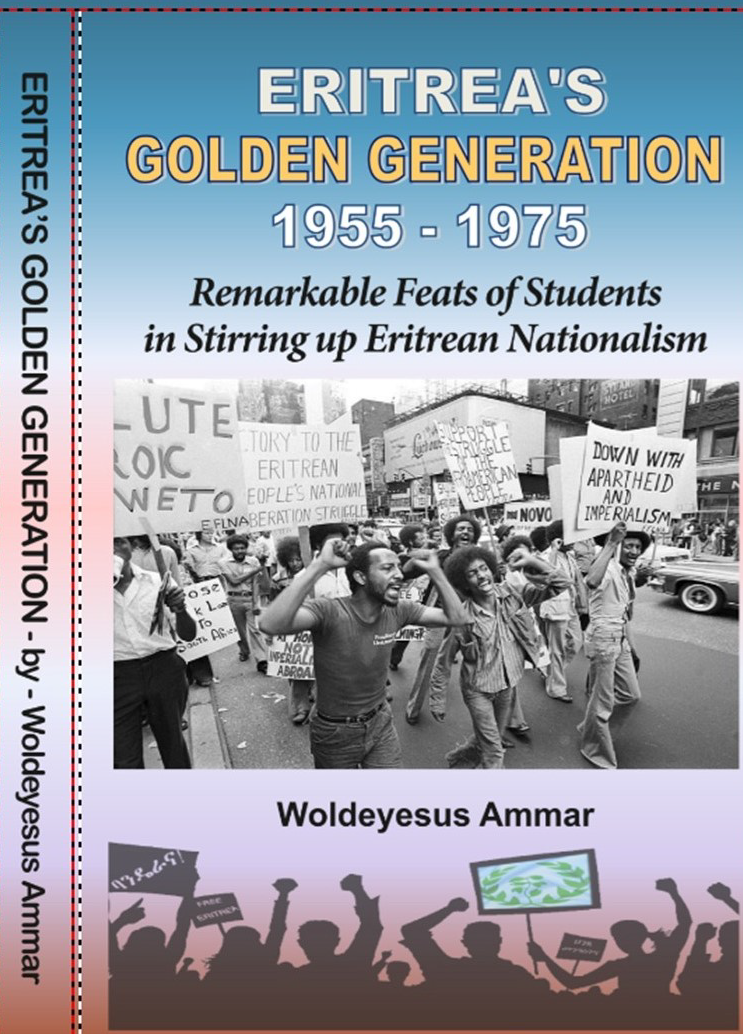
Book Description by Tesfai Woldemichael (Degiga) and Dr Zekarias Ginbot:
Eritrea’s Golden Generation (1955–1975) is a powerful and meticulously
documented account of the young Eritreans whose courage, intellect, and
activism ignited one of Africa’s most remarkable national liberation movements.
Drawing from decades of firsthand experience, Interviews, letters, and archival
materials, veteran author Woldeyesus Ammar chronicles how Students—from
middle schools in Keren and Asmara to universities in Ethiopia, the Middle
East, Europe, and North America—became the driving force of Eritrean
nationalism. Through vivid narrative and historical detail, the book traces major
turning points: the student-led uprisings of the 1950s and 1960s, clandestine
political cells in schools and universities, the spread of revolutionary ideas across
borders, and the rise of youth leaders who later shaped the Eritrean struggle for
independence.
Rightly describing Eritrea’s 1955-1975 generation as ‘Golden’, Wolde Ammar’s
new book is a ‘must read’ material on how Eritrean nationalism was bolstered by
a resilient breed of youth, whose activism eventually gave birth to a sovereign Eritrea.
This richly revised translation of his 2022 Tigrinya book ተመሃሮ ኣብ
ቃልሲ/Students in Struggle is a worthy gift to many non-Tigrinya readers, who
include a large segment of the youth in Eritrean diaspora. Needless to say,
many young Eritreans will come across names of close relatives – to some their
parents and grandparents – and obtain first-hand information of amazing
contributions they made in the struggle.
The 12 chapters of the book covered in nearly 300 pages narrate daring
engagements by young school boys and girls of that era. Starting with a
comprehensive introduction of the educational background of that new
generation that stirred up a new phase of nationalist struggle, the book highlights
the true factors that fueled the 1955-1975 generation to engage in a
nationalist struggle. Chapters two and three narrate in sufficient length the urban
struggle centered in Keren and Asmara and thence spreading the nationalist call
to the rest of the country. The same generation of students also conveyed to
Addis Ababa and Bahr-Dar the call for a new struggle to realize the Eritrean
people’s aspirations for statehood, as told in chapters five and six of the book.
Going parallel to what was being undertaken in Eritrea and Ethiopia, young
Eritreans, who migrated to the Sudan and Egypt for educational opportunities,
were engaged in an equally amazing nationalist action. As told in chapters seven
and eight, their story starts with the establishment of a youth club in Cairo way
back in 1952. Their militancy reaches its milestone with the initiative of founding
an organization that eventually led to launching armed struggle in 1961. The
challenges the nascent armed struggle faced in the 1960s and early 70s is very
well told under chapter nine together with persuasive evidences exposing some
fabricated narrations by Ethiopia and Eritrean elements. Eritrean students in
Europe and North America had joined the phase of nationalist reawakening a bit
late after 1970, but all the same, their participation was very effective, as
narrated under chapter ten. Chapter eleven informs about the
essential exchanges of influence between the Eritrean and Ethiopian student
movements followed in chapter twelve about biographies of a few student
leaders of that momentous epoch. And the book ends with an educative epilogue
that no good reader of Eritrean history should miss. — Good Reading!

Comments