


Fathi Othman
Before attempting to answer this fundamental question, let us first examine the motives and causes behind it.
Reflecting on the fate that awaits Afwerki does not stem from any personal affection for him or admiration for his history; rather, it is driven by a gut-wrenching, visceral pain—a pain felt by the writer, which seeps through the words to the reader. Many of us harbor this pain, much like a cancer that grows and expands within us day by day.
This is because the vast majority of us—whenever possible—avoid contemplating the country’s fate should Afwerki fall, regardless of how that fall might come about. Such reflection inevitably brings a more critical question to the fore: Does the fall of Afwerki signify the fall of Eritrea itself?
Before the questions multiply and the potential answers branch out, let us return to the central question of this piece: Why will Afwerki’s fall be both imminent and resounding?
His fall will be imminent—at least when measured against the lifespan of nations—because the natural duration of his rule, both biologically and politically, is nearing its end. It will be a resounding fall because the vortex that follows it will have far-reaching consequences.
If a sincere, patriotic group from within the country were to bring an end to his rule, the answer to the second part of the question would change—though it would inevitably give rise to further questions. If his removal from the scene is violent, the resulting vortex could be devastating. Conversely, if the transition is managed with calm and wisdom, it might dispel the dread surrounding that second question—the fear that Afwerki’s fall could mean the collapse of Eritrea—which is the sincere hope of all who care for the nation. As for his potential fall due to external pressures—whether political or military—this brings a second question to the forefront; a question that terrifies all Eritreans, with the exception of those actively preparing for his ouster from abroad.
Before addressing this second question, let us examine some historical lessons regarding the fall of an “absolute ruler” and the fate of the state over which he presided.
A prominent example from modern history is Louis XVI, the last King of France, who was executed in a public square. His fall did not mean the collapse of France as a nation, a country, or a people; rather, it marked the end of a monarchy that had endured for a thousand years. The “Ancient Régime”—with its monarchy, privileges, class distinctions, ruling authority, and prevailing values—did indeed collapse.
This collapse paved the way for the arduous, long-term emergence of a “new” France.
A second example—often invoked by those who wish to instill fear—is that of Muammar Gaddafi. When he fell, his vision of a “Great Socialist People’s Libyan Arab Jamahiriya” collapsed along with him, as did the pervasive climate of fear, the appropriation of the state by an individual and his family, the “revolutionary committees,” the “Green Book,” and everything his regime represented. The country and its people remained, left to confront the consequences of his despotic rule.
What Libya faced was the direct result of years of one-man rule, in which the leader had inextricably linked the nation’s fate to his own—a common outcome for those who act as if they are the state, and the state is them.
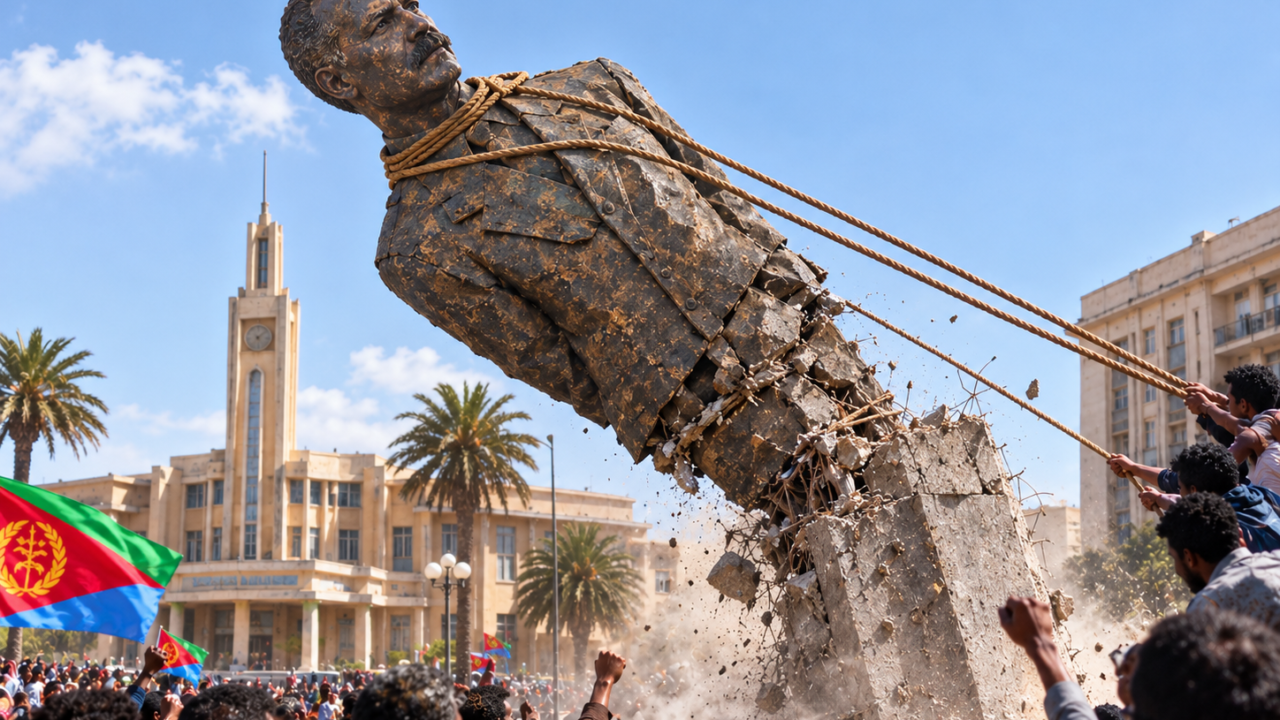
Throughout his bleak years in power, Afwerki has tethered the state to himself; wherever he walks—or stumbles—the state follows, sharing his fate. Yet, the fall of Afwerki would signify the collapse of the power structure he built, the prison he constructed, and the terror he spread.
Why, then, does the prospect of Afwerki’s fall seem so frightening—even to those within his inner circle and his own supporters? Those closest to him, as well as his more distant supporters, fear his impending fall—largely because they have no idea what will become of them once he is gone. And if they cannot foresee their own fate, they are even less capable of anticipating what will befall the country—assuming, of course, that the fate of the nation concerns them at all.
Everyone—whether a supporter of Afwerki or one of his detractors—knows that should he fall, there is no vice president to assume power, no parliament to appoint an interim leader, and no political party to designate a successor. On the horizon, there is neither an individual nor an institution that could serve as a buffer to absorb the shock of his collapse.
As for the factors accelerating his downfall, they have been brewing for years and have now multiplied: internal decay has crippled the nation’s vital structures, rendering it incapable of functioning. When a regime forces the elderly to take up arms, it is a clear sign that its defense system has collapsed—long before a single shot has even been fired at it. The regime’s legitimacy, meanwhile, is like a tent swept away by the wind into an abyss. As for the exhaustion of options, it stems from the mounting external and internal threats.
Regarding external dangers, he is now facing the repercussions of his intervention in the Tigray War (2020–2022). These consequences are seismic in nature, and the old tricks he once relied upon may no longer suffice to manage them.
Since we are discussing his potential fall, it is worth addressing the argument held by some—that rulers fall solely due to external factors. Let us turn once more to the pages of history. Rome, for all its grandeur and majesty, did not fall solely due to the incursions of Germanic tribes; it had grown old and decrepit, merely waiting for someone to deliver the coup de grâce.
Similarly, Al-Andalus did not fall solely because of the alliance between Ferdinand and Isabella; the infighting among the rulers of its petty states served as an open invitation to ruin and destruction. In the same vein, the structural weaknesses within the Ottoman Empire invited its eventual collapse.
For these reasons—and others that space here does not permit us to detail—the fall of Afwerki has become imminent. Given the likely manner in which it will unfold, that fall will be resounding.
A formidable challenge that the Eritrean people will face is the task of recovering from the long years of the “Afwerki malaise” and the aftermath of his eventual downfall.
In short, the conflation of Afwerki with Eritrea—the notion that he is the nation—only serves to magnify the losses, both today and in the future. As we noted in a previous article, unless a painful yet decisive “surgical” separation is made between the country and its sole ruler—a tragic link the ruler himself spent his entire life forging—the consequences will be dire. The period preceding Afwerki’s fall—characterized by a protracted state of “neither war nor peace”—may well prove to be one of the greatest pressures weighing upon the Eritrean people, both at home and abroad, compelling them to seek significant, nation-centered alternatives.
The Eritrean people may now have the opportunity to effect this critical separation between the fate of the ruler and the fate of the nation. Only then will they be capable of safeguarding their land against historical Ethiopian ambitions and establishing relations based on mutual parity and the sovereign choices of the people.

Fathi Osman is a former Eritrean diplomat and writer, known for his critical stance towards the Eritrean regime and his writings on issues concerning his country. He held several positions in the Eritrean government, including at the Ministry of Information, the Zeggar Hanish Commission, and the Office of the Legal Advisor to the President, as well as at the Eritrean embassies in Pakistan and Saudi Arabia, before seeking political asylum in France.


Comments