


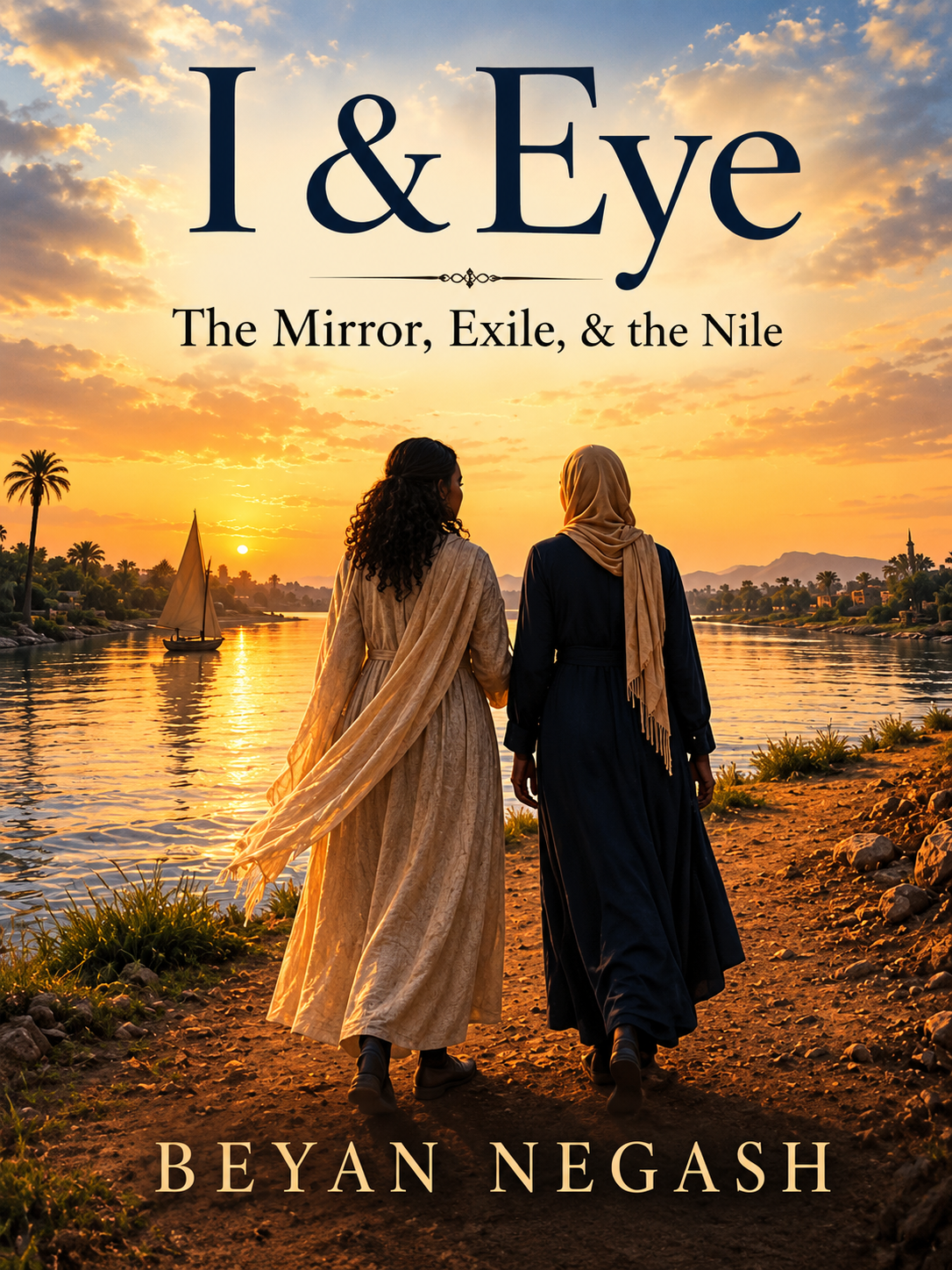
Book Review by Amer S. Hagos
Title: I & Eye: The Mirror, Exile & the Nile
Author: Beyan Negash
Genre: Literary Fiction
Year: 2026
Pages:209
Format: Paperback
ISBN: 979-8-292-39529-4
Available from: Amazon and other online booksellers
Reading Beyan Negash’s I & Eye: The Mirror, Exile & the Nile required me to cross a boundary of my own. My background has trained me to approach a text by searching for verifiable facts, arranging evidence, establishing chronology, and stating conclusions as directly as possible. Most of my own writing has been nonfiction, concerned with history, politics, science, research, and the documentation of people and events. A lyrical novel asks something different of its reader. It does not abandon truth, but it often approaches truth indirectly, through image, memory, silence, repetition, and suggestion.
That difference became part of my experience of this book. At first, I wanted to identify and explain every reference. I found myself investigating the writers, thinkers, and liberation leaders who appear in its intellectual world. Gradually, however, I understood that the novel was not asking me merely to collect information. It was asking me to consider how knowledge enters a life, how history settles inside memory, and how the person who has been displaced learns to see both the homeland and the self-anew.
I & Eye is therefore best approached as a lyrical and symbolically layered literary novel. It follows Sumaya through landscapes shaped by Sudan, Eritrea, war, migration, and competing inheritances. Yet its movement cannot be measured only by the events of a conventional plot. The reader also moves through photographs, letters, songs, names, fragments, and silences. Personal and political histories repeatedly enter one another. What may initially appear to be interruption becomes part of the design: memory does not always arrive in chronological order, and exile does not divide the past neatly from the present.
The novel’s form may unsettle a reader who expects each scene to explain itself immediately. Its short passages and elliptical turns require patience. But this demand is also one of the book’s achievements. The reader is not permitted to remain a spectator waiting for the story to supply a single settled meaning. We are asked to participate, to connect what has been separated, and to notice what an official account might leave unsaid.
The Self and the Witness
The title offers the first key to this method. “I” names the self: the consciousness that experiences, remembers, suffers, and speaks. “Eye” names the faculty that observes and interprets. Because the two words sound alike, the title draws the person who lives an experience close to the person who later looks back upon it. Yet the ampersand also keeps them slightly apart. The self and the witness are joined, but they are not identical.
This tension matters in a novel about displacement. Exile can make a person both participant and observer, someone who belongs to a history and someone compelled to examine it from a distance. The question is not only, Who am I? It is also, Through whose eyes have I learned to see myself? The title thus carries a political question inside a personal one. Colonial education, racial classification, national myth, and the gaze of others all compete to shape the reflection.
The mirror deepens that question. A mirror appears to return what stands before it, but it also reverses the image. It can reveal, distort, divide, or surprise. In the novel, it becomes a means of self-examination and fragmented recognition. The person in exile may investigate it and encounter several selves at once: the self-formed in the homeland, the self-remade by displacement, and the self-reflected through other people’s expectations.
For this reason, the mirror is not merely a symbol of private identity. It also invites nations and political movements to examine themselves. Liberation can become its own flattering reflection if it remembers sacrifice but refuses to look honestly at disappointment, exclusion, or the misuse of power. The mirror asks whether independence has fulfilled the dignity promised in its name, and whether the postcolonial state has truly escaped the habits of domination it inherited.
Exile as an Inner Condition
The novel treats exile as more than removal from a territory. A person may cross a border once but continue crossing it inwardly for years. Language, memory, family, and inherited grief travel with the displaced person. Home remains present precisely because it is absent.
This paradox gives exile both its wound and its insight. Distance can produce loneliness, cultural dislocation, and a divided sense of belonging. It can also give the exile a wider view from which to reconsider the homeland and the adopted country. To live between worlds is not automatically to possess superior understanding, but it may expose contradictions that settled belonging allows people to ignore.
Sumaya’s journey places this condition within a wider regional history. Sudan and Eritrea are not simply backgrounds against which an individual drama occurs. War, migration, racial perception, and political inheritance enter the characters’ intimate lives. History is not outside the person. It shapes the way one remembers, loves, speaks, and withholds speech.
The fragments and silences of the novel are especially important here. They should not be treated simply as incomplete writing. They suggest the way difficult memory operates through returns, gaps, flashes, and unfinished accounts. Silence may indicate pain that ordinary narration cannot contain, but it may also reveal voices removed from official archives. The novel asks us to listen not only to what is declared, but to what survives at the margins of declaration
The Nile as Witness and Archive
If the mirror holds the problem of seeing, the Nile holds the problem of time. The river moves constantly and yet remains recognizable. It carries life, migration, danger, civilization, memory, and return. It joins places that political borders separate, and it outlasts the governments that attempt to define history within those borders.
The Nile can therefore be read as both witness and archive. Unlike an official archive, however, it does not arrange the past into authorized files. It bears traces. It carries what communities remember even when institutions neglect or suppress it. In this sense, the river is not passive scenery. It has a presence within the novel’s moral imagination.
This use of the Nile also places I & Eye in conversation with Tayeb Salih’s Season of Migration to the North. Both works are concerned with movement between Africa and Europe, divided identity, the colonial encounter, and the psychological consequences of migration. Yet conversation does not mean imitation. Negash’s novel enters that literary current from its own Eritrean and Sudanese crossings, and through Sumaya’s distinctive encounter with memory, gender, inheritance, and exile. The river connecting the works also reveals the different historical burdens each one carries.
A Constellation of Liberation
My effort to understand the novel led me to the writers, thinkers, and liberation leaders named or evoked within it: Edward Said, Frantz Fanon, Chinua Achebe, Mahmoud Darwish, Ngugi wa Thiong’o, Thomas Sankara, Amilcar Cabral, James Baldwin, Steve Biko, and Patrice Lumumba. At first, I approached them one by one. I wanted to know their histories, arguments, struggles, and deaths. That study was valuable, but their deeper importance to the novel became clearer when I began to see them as a constellation.
Together, they illuminate several connected forms of liberation. Lumumba, Cabral, Sankara, and Fanon confront political rule, material control, and the unfinished promises of independence. Said, Achebe, Ngugi, and Darwish show that domination also acts through representation, language, culture, and the power to decide whose account will be accepted as truth. Biko and Baldwin insist that oppression enters the mind and the intimate life, making self-definition and moral truth-telling necessary forms of resistance.
Their presence widens the meaning of freedom. Liberation cannot be reduced to the removal of a foreign flag. A country may attain formal independence while its resources remain externally controlled, its institutions reproduce inherited inequalities, or its leaders silence the people in whose name independence was won. Political freedom without cultural confidence and psychological dignity remains incomplete.
This is where the title’s mirror becomes political once more. Said helps us ask who constructed the image in which the East was expected to recognize itself. Ngugi asks what happens when colonial education separates people from their languages. Biko asks how oppression survives when its judgments become internalized. Achebe restores African societies to the center of their own histories. Darwish shows how language can preserve a homeland when possession of the land has been lost. Baldwin demonstrates how distance from one’s country may sharpen the obligation to speak truth about it.
The liberation leaders add a further question: what becomes of a national promise after sovereignty? Lumumba, Cabral, Sankara, and Biko did not live to see the full consequences of the futures they imagined. Their deaths represent interrupted possibilities, but they should not be reduced to heroic icons. Their ideas ask whether present generations can distinguish remembrance from repetition, and honor from uncritical reverence. Fanon’s warning about a national elite inheriting the colonial structure is especially relevant. A revolution may defeat one form of domination while preserving another.
Seen together, these figures help clarify the novel’s movement from the political into the personal. Colonialism, racism, revolution, and authoritarianism are not presented as distant subjects to be studied separately from daily life. They remain active in memory, language, family, and the question of belonging. The struggle to reclaim land and institutions is inseparable from the struggle to reclaim the authority to name one’s own experience.
Reading as Participation
My scientific and nonfiction habits initially made me want the novel to yield a clear account: this happened, then that happened, and therefore this is the meaning. I & Eye taught me to recognize another kind of discipline. Lyrical fiction may leave space without abandoning precision. A metaphor can carry historical knowledge. A repeated image can reveal a connection that an explanation might flatten. A silence can force the reader to confront the absence of a voice rather than allowing a narrator to speak comfortably on its behalf.
This does not mean that every ambiguity must be admired or that every reader will experience the book in the same way. The novel asks much of its audience, and readers drawn mainly by plot may find its reflective movement demanding. Its many intellectual references can also tempt the reader to leave the novel and pursue the history surrounding it, as I repeatedly did. Yet even that difficulty proved productive for me. The book became not only an object I read but a doorway into African, Black, Middle Eastern, and postcolonial traditions I had not studied closely enough.
Different readers will enter through different doors. One may follow Sumaya’s personal story. Another may be drawn to the Nile, the mirror, or the silences. A reader shaped by exile may recognize the strange condition of feeling attached to a place from which one is absent. A reader of political history may see the unfinished question of liberation. These interpretations need not cancel one another. The novel’s layered form permits them to meet.
The most important lesson I take from the book is that reading deeply is itself a form of participation. Context does not replace the novel, but it enlarges what we are able to notice within it. Learning about Said, Fanon, Achebe, Darwish, Ngugi, Sankara, Cabral, Baldwin, Biko, and Lumumba did more than supply background information. It gave me additional eyes through which to recognize the book’s questions about power, dignity, historical truth, and self-perception.
An Invitation to See More Deeply
I & Eye: The Mirror, Exile & the Nile is a meditation on what happens when private memory meets public history. Through Sumaya’s journey and its recurring images, the novel explores the self that remembers, the eye that witnesses, the mirror that both reveals and reverses, and the river that carries histories across generations and borders.
The book does not offer liberation as a completed achievement. It presents it as an unfinished labor involving territory and government, but also language, culture, memory, and the mind. It asks who possesses the authority to narrate the past, whose suffering enters the archive, and whether the exiled person can construct a self without surrendering either origin or change.
I began this reading conscious of my limited experience with literary fiction. I end it with a greater appreciation for what a novel can contain and what it can awaken. I & Eye led me into unfamiliar but fascinating literary territory and reminded me that learning does not end when one leaves one’s established field. Sometimes a book becomes valuable not because it confirms what we know, but because it teaches us how much more there is to see.
Amer,
There is something particularly moving for a writer in discovering not simply that someone has read his book, but that the book has accompanied the reader somewhere. Your review gives me that feeling.
What touches me most is the journey within your reading itself. You did not approach I & Eye already possessing the vocabulary through which you eventually came to understand it. You describe having to slow down, reconsider what you expected a novel to do, and learn to read beyond event and information toward memory, symbol, silence, exile, and the inner life of the narrator. In that sense, your review becomes partly the story of a reader discovering another way of reading.
For that, Amer, I thank you deeply. Indeed, there is something here for another reader as well.
A novel need not surrender everything at first encounter. Sometimes the difficulty, the pause, even the moment of wondering, “What am I supposed to make of this?” is not a failure of reading. It may be the beginning of it. Different readers will enter I & Eye through different doors. One may enter through Eritrea, another through Sudan and the Nile, another through exile, migration, memory, identity, or simply through the experience of being caught between the person one was and the person one has become.
And perhaps that is where your review does something beyond reviewing I & Eye. It invites the next reader not necessarily to see what you saw, but to trust what he or she may see differently.
That, to me, is when a book begins to have a life beyond its author.
Thank you for reading I & Eye with such care, and especially for allowing us to see the reader changing alongside the book.