

By Beyan Negash
Crossings | Farajat
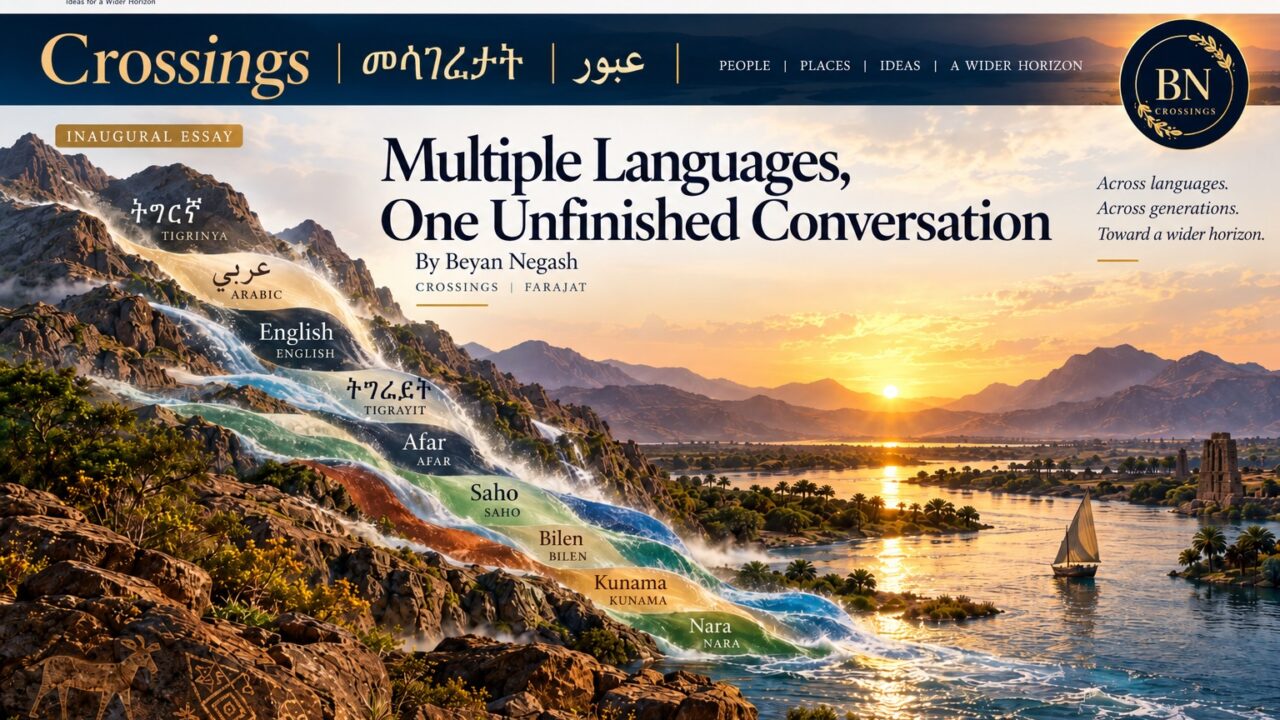
Somewhere in the Eritrean digital world, many conversations may be taking place at once. Some unfold in Tigrinya, others in Arabic, Tigrayit, Afar, Bilen, Saho, Kunama, or Nara. Still others travel through English and the languages of exile. They may concern the same country, revisit the same history, and confront the same unanswered questions. Yet each conversation can proceed as though the others were taking place on distant shores. The distance is not always geographical. Sometimes it is no wider than the space between two languages that have lived alongside each other for generations.
A writer publishes an essay in Arabic about the memory of the liberation struggle. A Tigrayit-speaking reader, who might challenge its interpretation or enrich it with another recollection, never encounters the argument. An English-language reflection on exile circulates among younger Eritreans abroad, while an older generation, whose experiences might complicate its conclusions, remains outside the exchange. The arguments exist. The readers exist. What is missing is often the passage between them. And so a peculiar condition emerges: a people whose history is deeply interconnected may find themselves conducting parallel conversations about their collective existence. This is not simply a problem of translation. It is a question of intellectual encounter.
The Languages We Inhabit
Languages do more than carry information. They carry histories of use, inherited associations, emotional attachments, and ways of recognizing the world. For Eritreans, Tigrinya, Arabic, and English occupy different but overlapping positions in the landscape of public expression. Yet the country’s linguistic and intellectual inheritance extends considerably beyond these three languages.
Tigrinya carries a substantial body of oral traditions, poetry, political commentary, and literary expression. Arabic connects Eritrean intellectual life to longstanding religious, educational, literary, and political traditions extending across the Red Sea and beyond. English has become an important medium for academic inquiry, international communication, and the writing of generations whose education or exile has brought them into other intellectual environments.
These are not exclusive territories. Nor are they the only languages through which Eritreans remember, think, and create. Tigrayit (also known as Tigre), with its rich oral and poetic inheritance, occupies an important place in Eritrea’s cultural and intellectual life. Afar, Saho, Bilen, Kunama, Nara, and other linguistic traditions likewise carry histories, memories, and forms of knowledge that cannot be reduced to their visibility in contemporary publishing.
Their presence is a stark reminder that a multilingual conversation cannot be defined solely by the languages that currently possess the widest channels of circulation. A language does not become intellectually significant only when it enters a newspaper, a university, or a digital platform. Its speakers have been interpreting their world, preserving memory, and transmitting knowledge across generations long before such institutions became available to them.
The present opportunity arises from the existence of public platforms where English, Arabic, and Tigrinya already coexist. These languages provide an initial means of communication, but they need not define the boundaries of the conversation. And coexistence is not necessarily conversation. Several languages may inhabit the same public sphere without their readers and speakers ever encountering one another’s arguments. A multilingual platform can become a collection of adjacent rooms, each furnished with its own assumptions, references, and familiar voices.
The doors may be open. That does not mean anyone is passing through them. The distinction matters because language is not merely the instrument through which we express an already completed thought. It also participates in shaping the thought itself. Consider the following scenario.
An argument develops in Arabic and may draw upon historical references and literary traditions less familiar to an English-language readership. A Tigrayit poem may preserve cultural associations and historical experiences that resist easy translation. A Tigrinya essay may depend upon proverbs or humor whose force diminishes when carried into another language. An English-language analysis may employ theoretical categories that illuminate an issue while obscuring elements more readily expressed through another intellectual tradition. None of these possibilities establishes the superiority of one language over another. They remind us instead that every language illuminates something while leaving something else in partial shadow.
A Shared History, Unevenly Remembered
Eritrean history has never belonged to a single language. The experience of colonialism, the struggle for independence, displacement, political organization, and the difficult decades following sovereignty have generated memories across regions, communities, generations, and continents. Yet those memories have not always entered a common public conversation.
Consider the history of Eritrean political organizing in exile. Students in Cairo, activists in Sudan, communities in Europe, and Eritreans in North America participated in overlapping political worlds, but their experiences were documented through different languages and institutional settings. The Eritrean Students’ Union House in Cairo offers a particularly revealing example. More than a physical gathering place, the House provided a setting in which students could organize, debate, and develop a sense of collective responsibility while living outside the homeland. Its institutional life reminds us that intellectual exchange does not occur in abstraction. It requires places, relationships, and opportunities for disagreement to become part of a shared experience.
The larger history of such institutions remains scattered across memories, organizational records, personal correspondence, and accounts preserved in different languages. Some memories survive in memoirs. Others remain in letters, oral recollections, poetry, and conversations that have never reached a wider readership. A historical account written in Arabic may preserve details absent from familiar English narratives. A Tigrayit oral recollection may reveal the emotional and social texture of an event that appears elsewhere primarily as a political milestone. A Tigrinya memoir may introduce another understanding of the same experience. An English-language study may place these accounts within a comparative historical framework.
What happens when these accounts are brought into conversation? Not necessarily agreement. Indeed, the encounter may expose contradictions that have remained comfortably undisturbed within separate readerships. One account may remember an event as an achievement. Another may recall its exclusions. A third may question the assumptions through which both have understood it. This is not a failure of collective memory. It is one of the conditions through which historical understanding becomes more substantial.
A shared history does not require a single authorized recollection. It requires the possibility that different recollections can encounter one another, challenge one another, and remain answerable to evidence. Ostensibly, one of the more consequential losses in Eritrean intellectual life is not the absence of writing, but the limited circulation of writing across the communities capable of interrogating it. What this would conceivably show is that arguments have been produced but have not met their most interesting interlocutors.
Translation Is Not a Ferry Without Passengers
It is tempting to imagine translation as the obvious solution. An article appears in English. Someone translates it into Arabic. Another renders it into Tigrinya. The problem, apparently, has been solved. But translation is more complicated, and considerably more interesting. What of the Tigrayit-speaking reader whose historical knowledge has not entered any of these texts? What of the Afar storyteller, the Saho poet, or the Kunama or Bilen elder whose recollections may complicate the assumptions shared by the published accounts?
The problem is not simply that some readers cannot access an existing argument. It is also that some arguments have yet to enter the conversation at all. Words carry histories that do not always accompany them into another language. Political concepts may have different associations. A literary image may summon an entire cultural world in one language and remain strangely silent in another. Even apparently familiar terms such as nation, liberation, sovereignty, justice, and reconciliation can acquire different meanings depending upon the experiences through which readers have encountered them.
Translation therefore involves choices. What should remain literal? What requires explanation? What cultural reference can be carried across without losing its significance? And what must be allowed to remain unfamiliar? The translator is not simply transporting sentences from one shore to another. The translator is also interpreting the distance between shores.
Yet translation alone does not guarantee intellectual exchange. An Arabic rendering of an English essay may reach new readers without inviting them into the argument. A Tigrinya translation may circulate widely while the questions it provokes remain confined to its immediate audience. A Tigrayit oral account may contain an interpretation that has never been considered by either readership. The more ambitious possibility begins when translation generates a response.
An English essay receives an Arabic rejoinder. A Tigrinya reflection challenges a historical assumption. A Tigrayit speaker introduces a remembered poem or account that changes the terms of the discussion. That challenge prompts a revised argument, another translation, or a question that had not previously been asked. At that point, something important occurred. The languages are no longer merely reproducing one another’s contents. They are participating in the development of an idea. And perhaps this is where the distinction between multilingual publication and multilingual intellectual life becomes most visible. One makes texts available. The other makes encounters possible.
The Generations Between the Words
There is another dimension to this question that deserves attention. Language differences frequently intersect with generational experience. For many Eritreans whose formative years were shaped by the independence struggle, political language carries memories of sacrifice, organizational allegiance, and expectations that were once inseparable from the promise of national liberation. For those who came of age after independence, the vocabulary of political belonging may carry a different emotional weight.
For younger Eritreans raised abroad, English or another adopted language may provide the most accessible means of asking questions about a homeland they know through family stories, inherited anxieties, photographs, music, and occasional visits. These are broad tendencies, not fixed generational identities. Families, educational experiences, migration histories, and individual choices produce countless exceptions.
Still, the differences invite a question. What happens when the language in which a generation remembers is not the language in which its children ask questions?
A parent may possess an extraordinary historical memory but lack the vocabulary to communicate its political complexity in the language most familiar to the child. A younger person may command sophisticated academic language yet struggle to recognize the emotional significance of a Tigrayit expression, a Tigrinya proverb, or an Arabic recollection. Neither possesses the complete story. And neither necessarily recognizes what the other knows. The result can be a peculiar form of proximity without understanding. People share households, family histories, and national attachments while inhabiting different interpretive worlds.
Literature sometimes enters precisely where political argument has exhausted its possibilities. A novel can make a historical experience available without demanding immediate agreement about its political meaning. A poem can preserve an emotional truth that official narratives have neglected. A song can carry a memory across generations long after the circumstances that produced it have changed.
But literature, too, must travel. An Eritrean novel written in one language may remain largely unknown to readers of another. A poem may be celebrated within one community and scarcely recognized beyond it. An oral tradition may survive through generations of speakers while remaining almost entirely absent from the written accounts through which outsiders encounter Eritrean culture. The question, then, is not only how to translate words. It is how to make the experiences behind those words available for another person’s imagination.
Beyond the Comfort of Agreement
There is a danger in speaking of a shared conversation. The phrase can suggest that the desired outcome is consensus, as though the purpose of bringing different voices together were to discover that they have always agreed. That would be an impoverished understanding of intellectual exchange. Eritreans do not need another space in which disagreement is politely concealed beneath declarations of unity. Nor do they need a multilingual arrangement that merely reproduces established political divisions in different languages.
What is needed is a more demanding practice of listening and argument. A reader should be able to encounter an interpretation that unsettles familiar assumptions without immediately treating its author as an adversary. A writer should be willing to discover that an argument persuasive within one linguistic community encounters serious objections in another. Such exchanges require more than linguistic competence. They require intellectual generosity, historical curiosity, and the willingness to distinguish criticism of an argument from hostility toward the person advancing it. They also require an acceptance that translation may reveal differences that cannot be easily reconciled. That is not necessarily unfortunate.
The value of a conversation cannot be measured solely by the agreement it produces. Sometimes its greatest contribution is to make disagreement more informed, more precise, and less dependent upon caricatures of those who think differently. There is also a question of whose voices are invited into disagreement in the first place. A conversation cannot claim intellectual openness while remaining indifferent to the languages and traditions from which its participants are drawn. The objective is not to erase the boundaries between intellectual traditions. It is to make those boundaries more permeable.
The Conversation That Has Yet to Begin
What might such an undertaking look like in practice? It need not begin with an elaborate institution, a translation committee, or an ambitious declaration of cultural renewal. It might begin with a single essay. A writer publishes a reflection in English. An Arabic-speaking reader recognizes a missing historical perspective and responds. A Tigrinya writer introduces another interpretation. A Tigrayit speaker recalls a poem that unsettles an assumption shared by all three. Someone translates a passage. Another reader supplies a reference previously unknown to the participants. The original essay is no longer the center of attention. The conversation has acquired a life of its own. There is something modest about this possibility, and something quietly consequential.
For too long, much of Eritrean public discourse has been shaped by the urgency of political positions. Questions are often approached through the expectation that a writer must first establish where he or she stands. Yet intellectual inquiry sometimes begins elsewhere. It begins with the recognition that a familiar question has been asked differently in another language, remembered differently by another generation, or interpreted differently within another historical tradition. That recognition does not weaken conviction. It tests its foundations.
The pages of Farajat, with its English, Arabic, and Tigrinya presence, offers one possible setting for such encounters. The opportunity lies not simply in the availability of these languages, but in what writers and readers might choose to do with that availability, and in whose voices they might eventually invite into the exchange. No single platform can overcome the historical, political, and social obstacles that limit intellectual exchange. Nor should the languages presently represented in any publishing space be mistaken for the entirety of Eritrea’s linguistic inheritance. But a beginning need not claim to be a solution. It needs only create an opening through which something previously absent can enter.
It is readily imaginable that an Arabic essay will introduce an English reader to an unfamiliar chapter of Eritrean history. A Tigrayit poem will invite a discussion about exile that political commentary has been unable to sustain. A Tigrinya reflection will return, through translation and criticism, transformed by the very readers it had not originally imagined. In each case, the movement matters as much as the destination.
For the purpose of crossing, it is not to make every shore resemble the others. It is to discover what becomes visible when we look back from somewhere else. Eritreans have crossed deserts, seas, borders, and continents. Their histories bear the marks of extraordinary geographical movement. Yet some of the distances that remain most difficult to traverse lie within the languages through which those journeys are remembered. About time the next crossing ought not be geographical at all. It ought to begin when a reader encounters a voice that has been speaking nearby all along.
A conversation remains unfinished not because its participants have nothing more to say, but because some have yet to hear one another.
Comments