

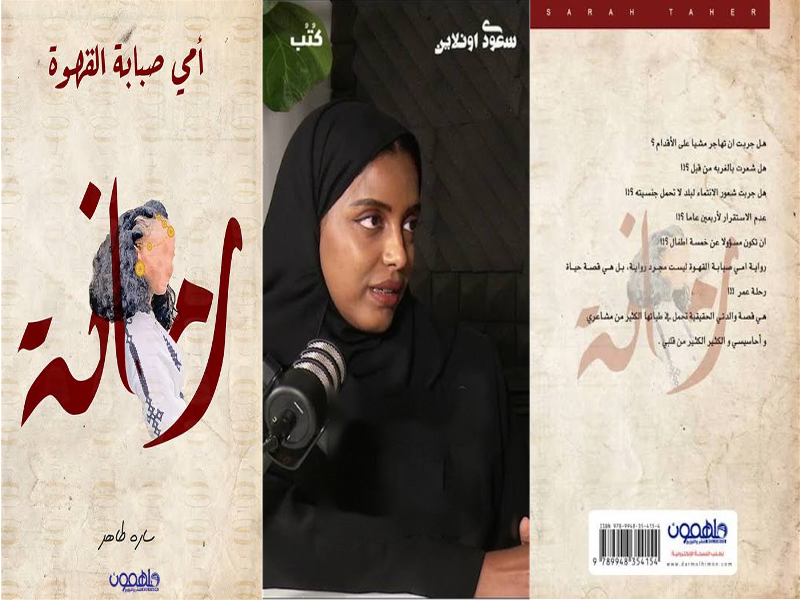
Author: Sarah Taher, an Eritrean novelist living in Riyadh
Publisher: Dar Molhimon for Publishing and Distribution, Dubai, 2020–2021, approx. 250 pages (in Arabic)
Introduction
The novel is the true-life story of the author’s mother, Rummana. The author presents it as “the story of a life, a lifelong journey” rather than as an imagined novel. The title comes from the image of the mother pouring coffee, as if the coffee gathering were a window onto her story and onto the family’s memory.
My Mother, the Coffee Pourer (Rummana) is a social novel set in an intimate family space in the Umm Al-Hamam district of Riyadh. It takes coffee, and the ritual of preparing and pouring it, as a central symbol that links the generations and carries connotations of longing, warmth, family memory and earning a living, for after her husband’s death Rummana works as a coffee pourer to provide a dignified life for her children in the land of exile.
Main Themes
- Migration on foot (from Eritrea to Sudan): The journey begins with an exhausting flight on foot, escaping the war that tore the homeland apart and scattered the family. The novel exposes the injustice of war and its role in dispersing Eritrean families.
- Exile and belonging: The mother lives in a country whose nationality she does not hold, and the novel asks a painful question: how can you belong to a place that does not officially recognise you? And who are you, between your original identity and your newly acquired one?
- Forty years without stability: A whole life of moving, anxiety and waiting for safety.
- Motherhood and responsibility: A wise, resilient woman who alone carried the responsibility of raising five children after the passing of her husband, who suffered illness and faced severe hardships in his final days. Despite the harshness of life, its challenges and the pain of dispersal, she held her family together.
Style and Value
The novel is written in simple, warm language and overflows with the author’s sincere feelings for her mother, even if it sometimes moves quickly from one subject to another. Dr. Abdullah Al-Ghadhami described it as “profound in its humanity and its creativity.” It expresses the questions of homeland, exile and belonging among Eritreans in Saudi Arabia. The author has a second novel, Umm Al-Hamam, which follows the same path in time and place.
In Summary
My Mother, the Coffee Pourer is a daughter’s tribute of loyalty to her mother, and a human testimony to the Eritrean experience of migration and refuge. It presents the mother as a symbol of patience, dignity and the ability to build a small homeland within the family when the greater homeland is absent.
It is a moving novel, and essential reading for many Eritreans living in exile. Directly or indirectly, it touches many aspects of life in the diaspora: the long journey away from the homeland, the uncertainty of belonging, the weight of responsibility, and the quiet strength of mothers who held their families together far from home. Many readers will find in its pages their own story, or the story of someone they love.
◆ ◆ ◆
When a Novel Becomes a Mirror of Our Own Stories
I bought My Mother, the Coffee Pourer (Rummana) a few years ago, and it waited for me on the shelf because I was busy, until I was finally able to read it. And what a surprise it was. I found a beautiful novel, charged with emotion, realistic and honest. It tells the life, and the tragedy, of an Eritrean family living in Riyadh, but in truth it stands for dozens, indeed thousands, of similar lives lived by Eritreans in exile.
This novel touches the hearts and feelings of many Eritreans abroad, and lays bare the challenges and tragedies of exile. Every Eritrean refugee has a story and a narrative of their own. Many of these stories are alike, even if they differ in the depth of their tragedies and the severity of their trials.
A Novel That Shook Me
This novel shook my emotions and touched my innermost self. It dug up buried memories from my subconscious mind, and they came back to me as vividly as if they had happened only yesterday. I read it with intense concentration and found beautiful storytelling, in language that is deceptively simple, and I found myself becoming part of the novel. At times I felt it was speaking about me; at other times, about so-and-so, or about the family of someone I knew.
Like the novelist’s mother, I left Eritrea for Sudan in 1975, and I know the experience of seeking refuge in Sudan. I also lived in Saudi Arabia, and I know first-hand true stories just like these: the illness of the father, head of the household, then his death; then the problems with the kafeel (sponsor) and the transfer of sponsorship; then some relatives and friends turning their backs and drifting away. These were people who used to visit the house often and benefited greatly while the father was alive, yet when he passed away, they abandoned his family. The novel speaks of ingratitude and disloyalty, the dark side of life.
The novel also speaks of relatives and friends interfering to make life miserable for a brother’s wife or others, a kind of domination that exists in our society, sadly.
This does not mean that life in Saudi Arabia was all dark and bleak. They are one side of life there, not the whole picture. Every society has its positives and negatives; in it are the good and the wicked, the generous and the mean. Fairness requires that we mention both faces, so that we neither generalise injustice to an entire people, nor hide goodness where it exists.
Just as the novel mentions Dr. Noura, the virtuous and noble Saudi woman who stood by the family in its ordeal, there are many good and charitable people in Saudi Arabia who quietly extended a helping hand to expatriates, without reproach or harm. We must remember them with goodness, acknowledge their kindness and preserve their favour, for they are the bright face that eased the harshness of exile for many of us.
The climax, however, came with the death of Taher, Rummana’s husband and the novelist’s father. At that moment I could not hold back my emotions, and my eyes filled with tears. The author managed to shake my very being, and she portrayed that moment masterfully.
The novelist Sarah Taher succeeded in conveying this story in a simple yet moving way; she is a distinguished writer. I wish her continued creativity and many more successful novels, Allah willing.
The novel speaks of wars and their devastating effects on peoples, and wars in Eritrea have not stopped to this day. It also speaks of exile and its challenges. As I experienced personally, life in Saudi Arabia was very hard for foreign residents, especially because of the “kafala” (sponsorship) system, which left the sponsored person subject to the mood of the sponsor and the extent of his humanity, without granting him any legal rights.
From One Exile to Another: Rummana’s Journey to Canada
After forty years in Saudi Arabia, Rummana finds herself forced to migrate once again, this time to Canada, with her son, his wife and their children. Forty years of her life, in which she built a home, memories and relationships, and then she packs her suitcase once more and starts from scratch in a land she does not know. This is one of the greatest tragedies Eritreans face in exile: that exile becomes an endless series of stations, and a person remains a migrant all their life, never settling anywhere, never returning home.
A Homeland Liberated, Yet With No Room for Its Children
Eritrea was liberated from Ethiopian occupation thirty-five years ago. It was expected to open its doors to its children scattered across the world. Instead, it became a country that drives its people away: unbearable to live in, and offering no one any reason to return. Indeed, flight and asylum from Eritrea continue to this day, because of a failed regime that has been unable to provide the basics of life, from drinking water, electricity and transport to jobs that guarantee a dignified living.
This regime has plunged the country into an atmosphere of instability through its continuous wars with its neighbours, and has imposed on young people an open-ended, indefinite national service that consumes the best years of their lives. Not content with this, it has practised arbitrary detention without charge or trial, abolished institutional and constitutional governance, and entrenched tyranny and political oppression.
Every refugee in the world dreams of returning home one day, even after a long absence, except the Eritrean. Everyone wants to leave Eritrea, especially the young, in search of a dignified life and a better future. What a painful irony: a people who fought for thirty years for a free homeland, only to see their children flee from it!
What Comes After Life in the West?
Here another story begins, one not yet told. How does a woman in the autumn of her life move from a country where temperatures exceed forty degrees Celsius to one where they drop to forty below zero?
The cold is not the only challenge. There is a new language, different customs and traditions, and a social life entirely unlike anything she knew: no neighbours knocking on the door, no coffee gatherings bringing loved ones together as they did in Riyadh. It is exile of another kind, an exile within exile.
How will Rummana live through this stage? Will she find in Canada the stability she searched for during forty years? Or will longing keep pulling her back to both Eritrea and Riyadh? The novel leaves these questions open, for readers to imagine the details and complete the story themselves. Perhaps they will become the material for a future novel by Sarah Taher.
Comparisons That Moved Me
After finishing My Mother, the Coffee Pourer (Rummana), I found myself recalling two other mothers immortalised by world literature and cinema: Nilovna in Maxim Gorky’s novel Mother, and Radha in the famous Indian film Mother India, known in the Arab world as Min Ajl Abna’i (“For My Children”).
Rummana’s Sacrifice in My Mother, the Coffee Pourer
Rummana sacrificed her homeland when she migrated on foot, fleeing war. She sacrificed her stability, living for about forty years in exile without citizenship or security. And she sacrificed her comfort: after the death of her husband, Taher, she alone carried the responsibility of five children, and faced the harshness of life and the abandonment of some relatives. Hers was a silent, daily sacrifice, made inside the home and far from the spotlight.
A Brief Summary of Mother by the Russian Writer Maxim Gorky
The novel tells the story of Nilovna, a poor, simple Russian woman who can neither read nor write. For many years she lived in fear with a harsh, drunken worker for a husband. After his death, her son Pavel changes; he gives up drinking, starts reading books, and joins the workers demanding justice and freedom against the oppression of the Tsar.
At first, the mother is terrified for her son. But she listens to his ideas and those of his comrades, comes to understand them, and believes in them. When Pavel is arrested, she continues his path: she smuggles leaflets, joins demonstrations, and attends his trial. In the end, Pavel is exiled to Siberia, and the mother is arrested at a railway station while distributing her son’s speech to the people. She is beaten as she cries out that truth cannot be drowned in blood.
Nilovna sacrificed her fear, transforming from a frightened woman into a brave one who stood up to the police. She sacrificed her safety, exposing herself to prison and beatings for her son’s cause. And she even sacrificed herself for others: she was no longer the mother of Pavel alone, but the mother of all the oppressed. Hers was a public, militant sacrifice, made in the streets and before the people.
The Film Mother India, Known in Arabic as “For My Children”
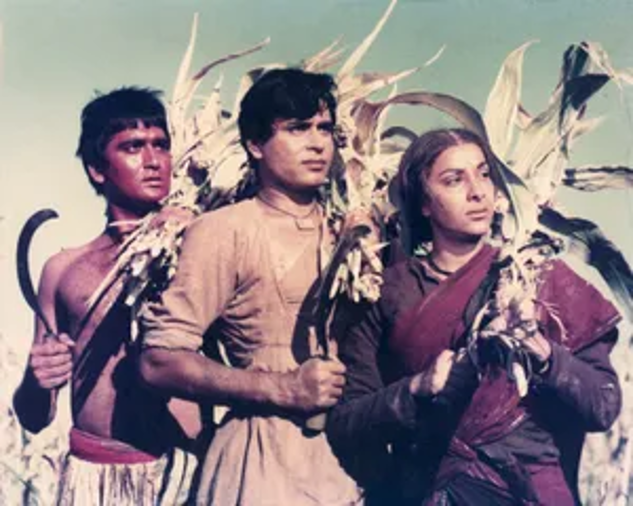
About the film: An Indian film released in 1957, directed by Mehboob Khan, starring Nargis as the mother, Radha. It is considered one of the greatest films in the history of Indian cinema, and was the first Indian film to be nominated for the Academy Award for Best Foreign Language Film.
The Story in Brief
Radha marries Shamu, a poor farmer. To cover the wedding expenses, her husband’s family borrows money from the greedy moneylender Sukhilala, who imposes unjust terms that give him three-quarters of the harvest, sinking the family into debt.
The husband suffers a tragic accident in which he loses both arms. Overwhelmed by helplessness and shame, he abandons the home. Radha is left alone with her children, ploughing the land with her own hands and pulling the plough in place of oxen. A flood strikes the village and one of her children dies, as she struggles against hunger and poverty. The moneylender tries to exploit her need, offering her food in exchange for her honour, but she refuses despite her hunger and holds on to her dignity.
Her two sons grow up: Ramu, calm and obedient, and Birju, rebellious and angry, who never forgot the moneylender’s cruelty to his mother. Birju becomes a bandit, and on the day of the moneylender’s daughter’s wedding he returns to take revenge and abduct her.
The climax: Radha had promised the villagers to protect the honour of their daughters. She stands before the son she loves more than anything, and when he refuses to turn back, she shoots him, and he dies in her arms. At the end of the film, Radha, now an old woman, inaugurates an irrigation canal for her village, a symbol of the birth of a new India.
Mother’s Sacrifice in the Film
Radha sacrificed her youth and her comfort and refused to sell her honour to feed her children. In the end, she sacrificed the most precious thing she had, her son, for the sake of justice and values. That is why she became the symbol of “Mother India” herself: the patient homeland that never breaks.
Linking the Three Mothers
| Radha (Mother India) | Nilovna (Mother) | Rummana (My Mother, the Coffee Pourer) | |
| The oppressor | The moneylender and poverty | Tsarist tyranny | War, exile and the kafala system |
| The husband’s absence | He abandoned her after his disability | He died, and had been cruel | He died, and had been her support |
| Type of sacrifice | Hard labour and dignity, then her own son | Safety and freedom for the cause | Homeland and stability for her children |
| The symbol | Patient India | The oppressed Russian people | The Eritrean mother in exile |
Conclusion: The three mothers are faces of one mother. Each was a simple woman who found herself alone in the face of injustice after the absence of her husband, and who carried her children and her dignity together without breaking. Radha sacrificed for dignity and justice, Nilovna through struggle, and Rummana through patience in exile. In the end, each became a symbol of her entire people.
◆ ◆ ◆
Gibran Khalil Gibran and the Image of Justice
Here I recalled lines by Gibran Khalil Gibran (1883–1931), the Lebanese-American poet, writer, philosopher and painter, and one of the leading pioneers of the Arab diaspora literary movement (Adab al-Mahjar) who helped renew modern Arabic literature. In his poem The Processions (Al-Mawakib), he writes:
Justice on earth would make the jinn weep, should they hear of it,
and would make the dead laugh, should they behold it.
Prison and death for wrongdoers who are small,
glory, pride and riches for those who are great.
The thief of a flower is scorned and despised,
while the thief of a field is hailed as a fearless hero.
The killer of the body is killed for his crime,
while the killer of the soul goes unknown to mankind.
(Translated from Arabic)
How many souls are killed every day, and no one knows… No killer is held to account, no grave is visited, no headstone bears a name. Yet they are not forgotten by Allah, and they will never be forgotten if there are those who write and tell their stories.
Does Exile Make Us Forget Our Homeland?
Is it true that the years in exile pass quickly, like a short dream from which we wake to find our hair grey and our life gone by? Can a person migrate in body while carrying the homeland within, in heart, memory, dialect and coffee cup?
Is longing for the homeland, and the dream of returning, a right that never fades with time, one that grows with us as we grow older? Or is time capable of everything, erasing the features and extinguishing the longing until it makes us forget our homeland?
Is the answer to adapt to our circumstances and live life as it is, no longer prisoners of the past, no longer hanging our lives on a return that may never come? Or is there, in adapting, a kind of silent betrayal of our memory and our roots?
These are questions every expatriate asks in moments of silence. Rummana asked them of herself through forty years of exile, as have thousands of Eritreans scattered across the world before and after her. None of them found a satisfying answer, because longing for the homeland is not an idea to be debated; it is a wound that lives in the soul.
So is there anyone who can teach us how “not to long”?
Teach me how not to long…
Teach me how to cut the roots of the memories of return from the depths…
Teach me how a tear dies in the eyes…
Teach me how longing dies, and how yearning takes its own life…
But no one can teach us that, because the homeland is not a place we leave; it is who we are.
Adapted from the poem “A Letter from Under the Water” (Risala min Taht al-Ma’) by Nizar Qabbani.
I send my letter from beneath the waters of exile, carrying the longing and yearning for return… a return that remains out of reach.
A Closing Word
When I closed the last page of My Mother, the Coffee Pourer (Rummana), I felt that I had not just finished reading a novel, but had risen from a long coffee gathering. I had sat with an Eritrean mother who poured me the cups of her life, one after another: the cup of war, the cup of migration on foot, the cup of exile, the cup of loss, the cup of ingratitude, and the cup of a patience that never runs dry. In every cup there was bitterness, but at the bottom there was always a little sweetness, called hope.
Rummana is not only Sarah Taher’s mother; she is the mother of each one of us. She is our mothers, who carried the homeland in their hearts when the homeland slipped from beneath their feet, who raised their children in exile to love a land many of them had never seen, and who poured coffee for every guest, while no one asked them about their pain.
This novel has taught us that literature is not a luxury, but the memory that rescues forgotten souls from a second death: the death of oblivion. How many souls have been killed without anyone knowing, and how many stories have been buried with their owners in the graveyards of exile? That is why I say to every Eritrean man and woman: write your stories, record the memories of your mothers and fathers, for if we do not write them, no one will.
The mother is the spring of tenderness and love, and the symbol of loyalty and sacrifice for her children. She stays awake so that her children may sleep, goes hungry so that they may eat their fill, and carries their worries in silence without expecting anything in return. The story of a mother is a story of sincere feelings; it deserves that we listen to it with all our senses and our whole being, because it is, in truth, the story of each one of us.
The mother is the one most deserving of kindness and honour, the symbol of sacrifice, devotion, purity and innocence. She is the root in whom the child takes pride, and the person most deserving of his good companionship, followed by the father in the right to kindness and companionship. Allah Almighty commanded us concerning her, saying: “And We have enjoined upon man [care] for his parents. His mother carried him in weakness upon weakness” [Luqman: 14]. And when a man asked the Messenger of Allah (peace be upon him): “Who among people is most deserving of my good companionship?” he said: “Your mother.” The man asked: “Then who?” He said: “Your mother.” He asked: “Then who?” He said: “Your mother.” He asked: “Then who?” He said: “Then your father.” (Agreed upon by al-Bukhari and Muslim).
And Rummana in My Mother, the Coffee Pourer is but a living image of this mother: a woman who carried the worries of her children in her heart throughout the years of exile, until she became an example for every Eritrean mother who carried the homeland in her heart and endured to the end.
Thank you, Sarah Taher, for writing with the loyalty of a daughter and the honesty of a witness. And thank you to every Rummana who endured, sacrificed and never broke.
I close with a prayer: O Allah, have mercy on our mothers and fathers who passed away in exile, protect those who remain, and restore to our people a homeland wide enough for all its children, one they return to rather than flee from, where they can sit together at a coffee gathering in which exile is no longer a guest.
Amer Saleh Hagos Muhammad
October 2026
Comments